

Consumer Insights
Uncover trends and behaviors shaping consumer choices today
Procurement Insights
Optimize your sourcing strategy with key market data
Industry Stats
Stay ahead with the latest trends and market analysis.
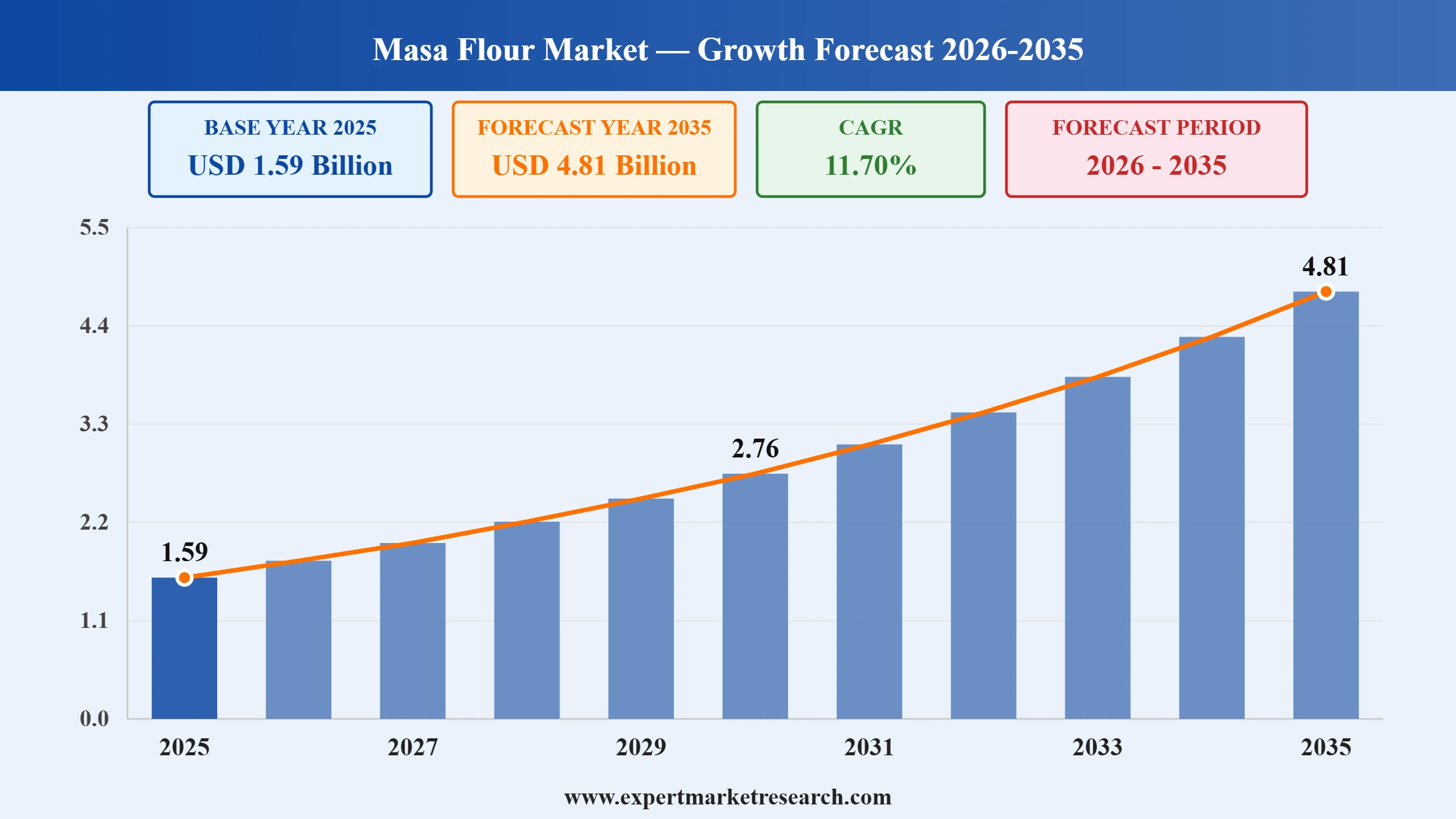
The global masa flour market was valued at USD 1.59 Billion in 2025. The market is expected to grow at a CAGR of 11.70% during the forecast period of 2026-2035 to reach a value of USD 4.81 Billion by 2035. The market is experiencing significant growth as manufacturers increasingly prioritize expanding production capacity and enhancing supply chain efficiencies to meet rising demand across retail, foodservice, and industrial segments.
The growing popularity of traditional and artisanal foods is driving the masa flour market growth as manufacturers are targeting heritage corn varieties and quality flours that provide better flavor and texture. Moreover, the increased demand of the foodservice market, which encompasses restaurants, bakeries, and ready-to-eat product lines, pushes producers to develop convenient and ready-to-use masa flour products. All these factors facilitate product diversification, build supply chains, and facilitate market growth.
Many companies operating in the masa flour market are also investing in high technologies in milling systems, automation, and quality control systems to guarantee consistent production of the products, increase efficiency of operations, and reduce waste. The reinforcement of logistics and distribution systems allow faster delivery to major markets and introduce new products as per changing consumer demands. Such strategic action plans also enable manufacturers to expand business, have competitive prices, and capitalize on export markets, thus increasing their market reach. For instance, in March 2025, Agristo Masa announced the INR 750 crore investment in the Uttar Pradesh plant to increase the production capacity and help local farmers in India. The investment highlights that infrastructure expansion and modernization remain key incentives of growth in the market.
Read more about this report - REQUEST FREE SAMPLE COPY IN PDF
| Global Masa Flour Market Report Summary | Description | Value |
| Base Year | USD Billion | 2025 |
| Historical Period | USD Billion | 2019-2025 |
| Forecast Period | USD Billion | 2026-2035 |
| Market Size 2025 | USD Billion | 1.59 |
| Market Size 2035 | USD Billion | 4.81 |
| CAGR 2019-2025 | Percentage | XX% |
| CAGR 2026-2035 | Percentage | 11.70% |
| CAGR 2026-2035 - Market by Region | Asia Pacific | 5.3% |
| CAGR 2026-2035 - Market by Country | Brazil | 6.1% |
| CAGR 2026-2035 - Market by Country | Mexico | 5.9% |
| CAGR 2026-2035 - Market by Application | Corn Chips | 5.5% |
| CAGR 2026-2035 - Market by End Use | Food Service | 5.4% |
| Market Share by Country 2025 | UK | 2.4% |
Grupo Maseca (Gruma) increased the number of hours of technical training that it offers to the small and medium-sized white corn producers throughout Mexico to 1,696 hours. This project will improve harvest and greenbelt practices and will incorporate farmers into the supply chain, which in turn will accelerate the growth of the masa flour market.
In collaboration with TESDA, Pilmico Foods Corp. launched the MasaGaling program, equipping bakers with advanced skills in masa-based baking. The initiative is expected to expand the Philippine masa flour market and strengthen the baking sector by enhancing technical skills and promoting new recipe development.
Third-party, independent testing confirmed that Maseca Instant Corn Masa Flour has trace, harmless amounts of arsenic. This will build consumer confidence, encourage wider adoption, and support market expansion through the availability of safer, high-quality products.
Unidos US and a number of Latino organizations petitioned the FDA to mandate that unfortified maize masa flour bear warning labels. By raising the demand for nutrient-enriched products, this marketing strategy will aid in promoting the usage of healthier fortified products, which will contribute to the overall masa flour market penetration.
Health-driven innovation is a significant factor driving the growth of the global masa flour market since producers are incorporating essential nutrients like folic acid into their products to meet consumer and population demands. Adding value to the process ensures fortification aligns with regulatory requirements while also meeting evolving health and wellness trends. For example, the United States FDA advocates the fortification of corn masa flour with folic acid to lower the cases of neural tube defects among infants, and this gives manufacturers guidelines on safe fortification. The initiative will help in the expansion of the market since it will help in filling nutrition gaps in most targeted population sectors.
The global masa flour market growth is influenced by ongoing innovations and the diversification of products and services since manufacturers offer premium, specialty, and organic masa harina to cater to changing consumer needs and preferences. Product line diversification enables brands to cater to health-conscious, convenience-driven, and premium segments, helping them stand out in a competitive market. These innovations also enhance product versatility for both home bakers and industrial applications. Since the establishment of organic Masa Harina in 2021, the King Arthur Baking Company has sold classic Latin meals such tortillas, pupusas, and gorditas.
Corn masa and nixtamalized flour are becoming more popular as consumers seek healthy and responsibly produced corn flour. More promising results of the growing use of corn-based products, such as tortillas and tortilla chips, are seen through efficient processing methods that can lower water and energy consumption and maintain nutritional value. These innovations contribute to the quality of production, efficiency, and competitiveness in the market. For instance, Buhler's Prime Masa facility, which was delivered to PV Sons Corn Milling in March 2022, exemplifies this masa flour market trend because it uses significantly less water and energy while producing high-quality nixtamalized flour.
The global masa flour market is witnessing an increase in product development as manufacturers create novel forms to satisfy changing consumer preferences and convenience expectations. Companies are adding specialty mixes and ready-to-cook meal solutions to their portfolios, as well as ready-to-use mixes and meal solutions that go beyond basic masa flour products and appeal to both home cooks and foodservice clients. For instance, building on its core offerings, Gruma offers new corn flour variants such as Maseca Antojitos and ready-mix products tailored for traditional recipes like sopes, empanadas, and chorreadas.
In order to meet the growing demand in North America and throughout the world, the leading manufacturers are streamlining their production and processing capacity, thereby contributing to the global masa flour market value. The companies' strategic actions, including Bunge's acquisition of its North America corn and masa milling enterprise in July 2025, are assisting companies in streamlining their operations, improving supply chain efficiency, and focusing on innovative product offerings, thereby increasing the availability and accessibility of high-quality masa flour for both commercial and foodservice applications.
The EMR’s report titled “Global Masa Flour Market Report and Forecast 2026-2035” offers a detailed analysis of the market based on the following segments:
Market Breakup by Nature
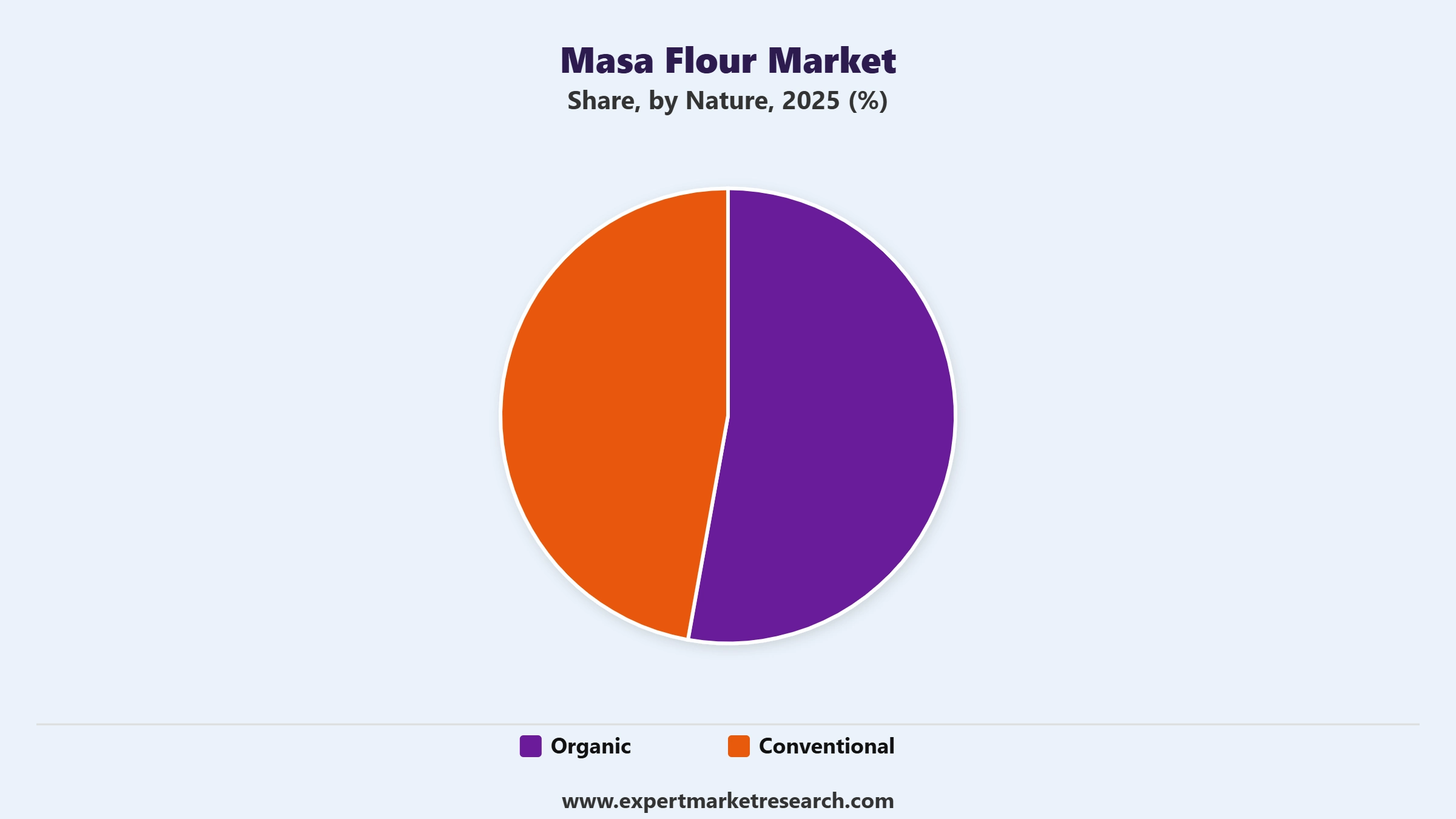
Key Insight: The masa flour market is categorized into organic and conventional products, with the organic alternatives witnessing higher demand as consumers increasingly seek non-GMO, clean-label, and health-conscious products. Companies such as Bob's Red Mill Natural Foods have expanded their organic masa harina lines, while conventional masa flour continues to dominate in retail and foodservice sectors due to its low cost and steady supply chain. In general, the industry benefits from the two-fold demand, and suppliers like as Cargill, Incorporated, and Bunge serve the two segments through innovation and distribution.
Market Breakup by Type
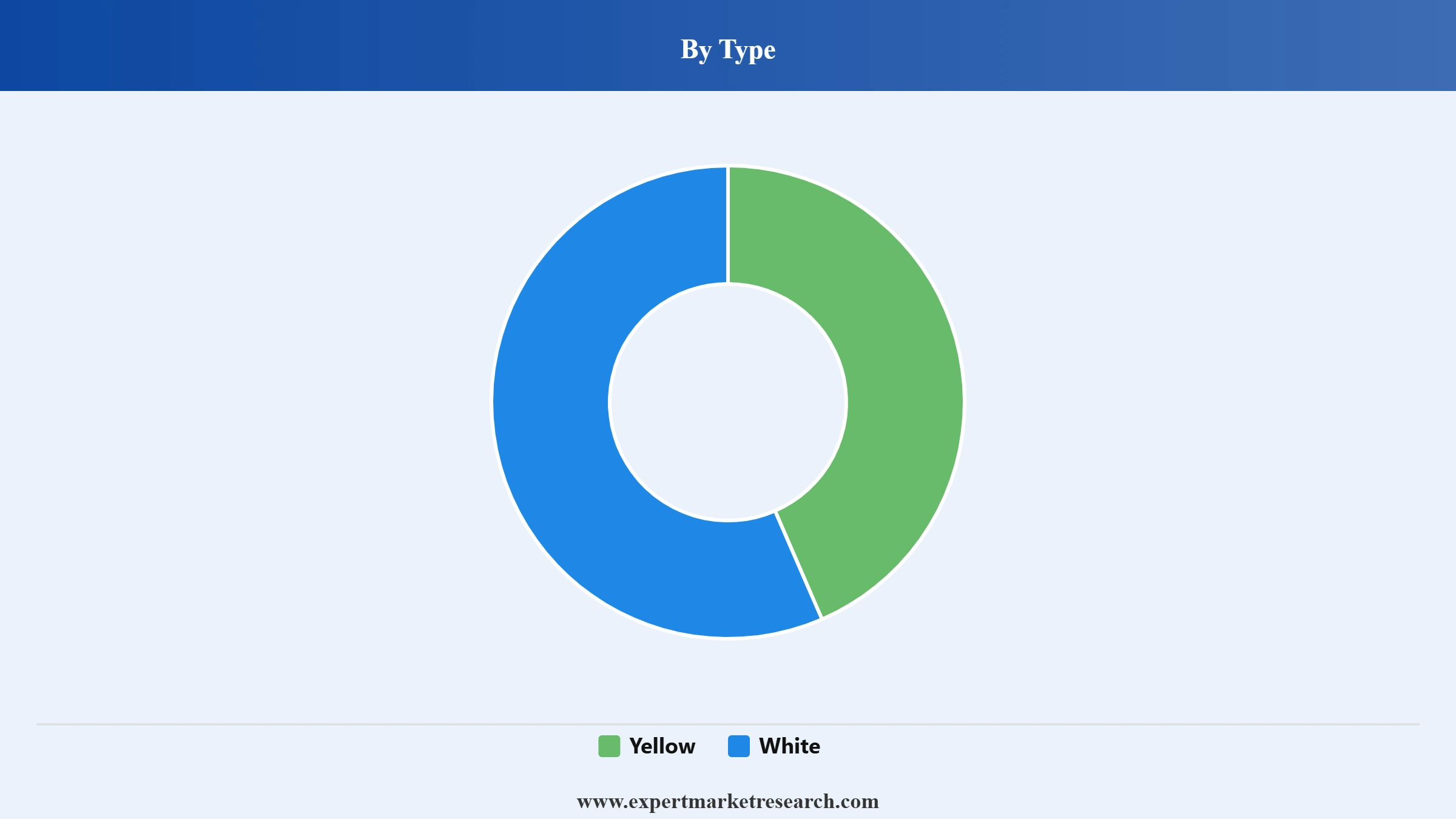
Key Insight: The masa flour market scope comprises yellow and white types of masa flour catering to the varying tastes of consumers. The use of yellow flour is increasing steadily owing to its increasing use in making tortillas, tamales, and corn chips. The white masa flour is currently being used in specialty and high-quality products to enhance them with a lighter color and natural flavor. The key suppliers, like Bunge Limited, are offering both yellow and white versions in organic and conventional form that support industrial and retail usage and help the market meet growing demand for product diversification.
Market Breakup by Distribution Channel
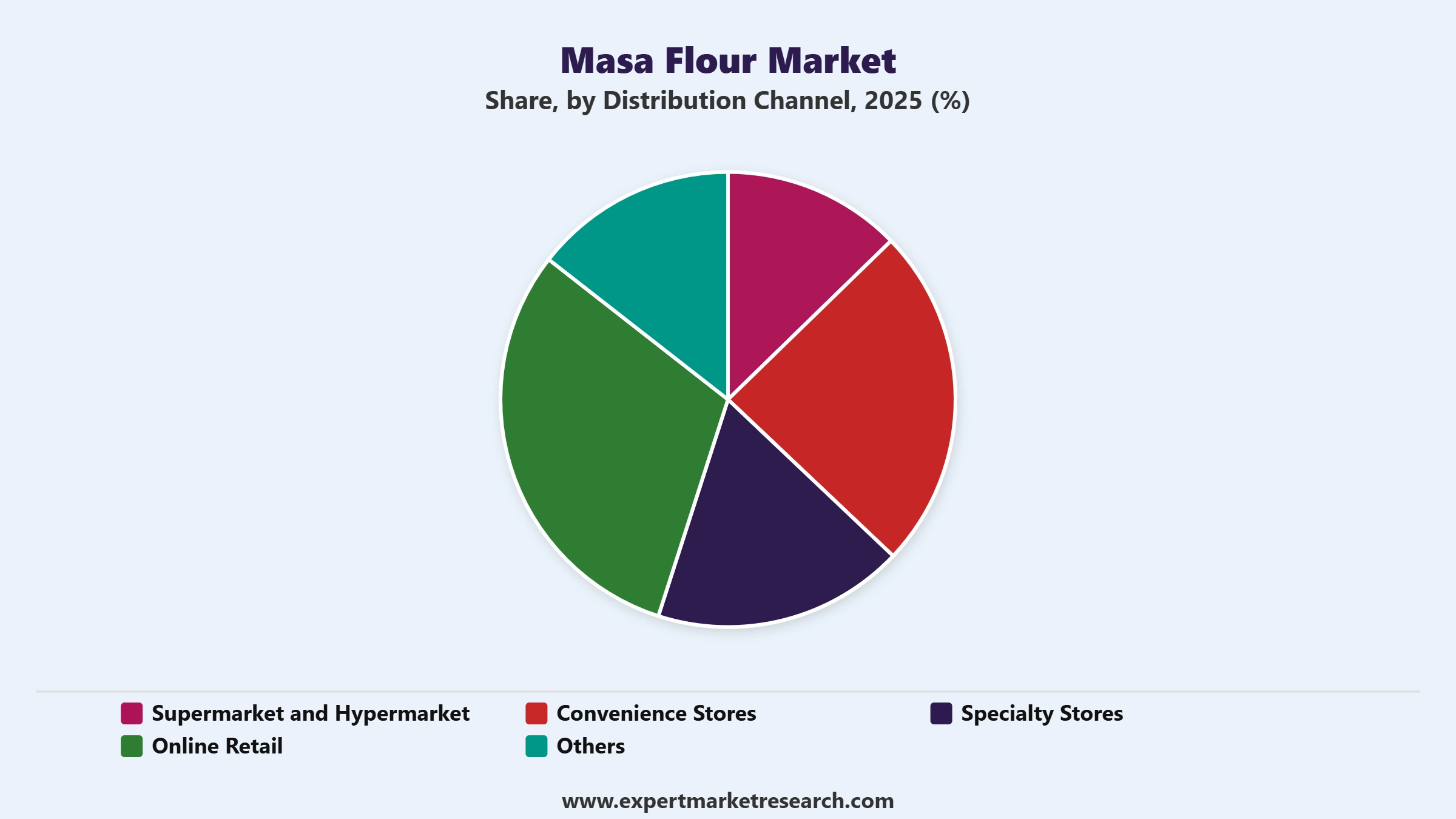
Key Insight: Distribution in the masa flour industry takes place through different channels, which include supermarkets and hypermarkets, convenience stores, specialty stores, and online stores. Online media has broadened the presence of the brands like Bob's Red Mill and Mission Foods, specialty stores assist in promoting artisanal and ethnic goods, and convenience stores promote purchases made on the move. The market is growing on these trends as the companies maximize the distribution to access both mainstream and niche markets.
Market Breakup by Application
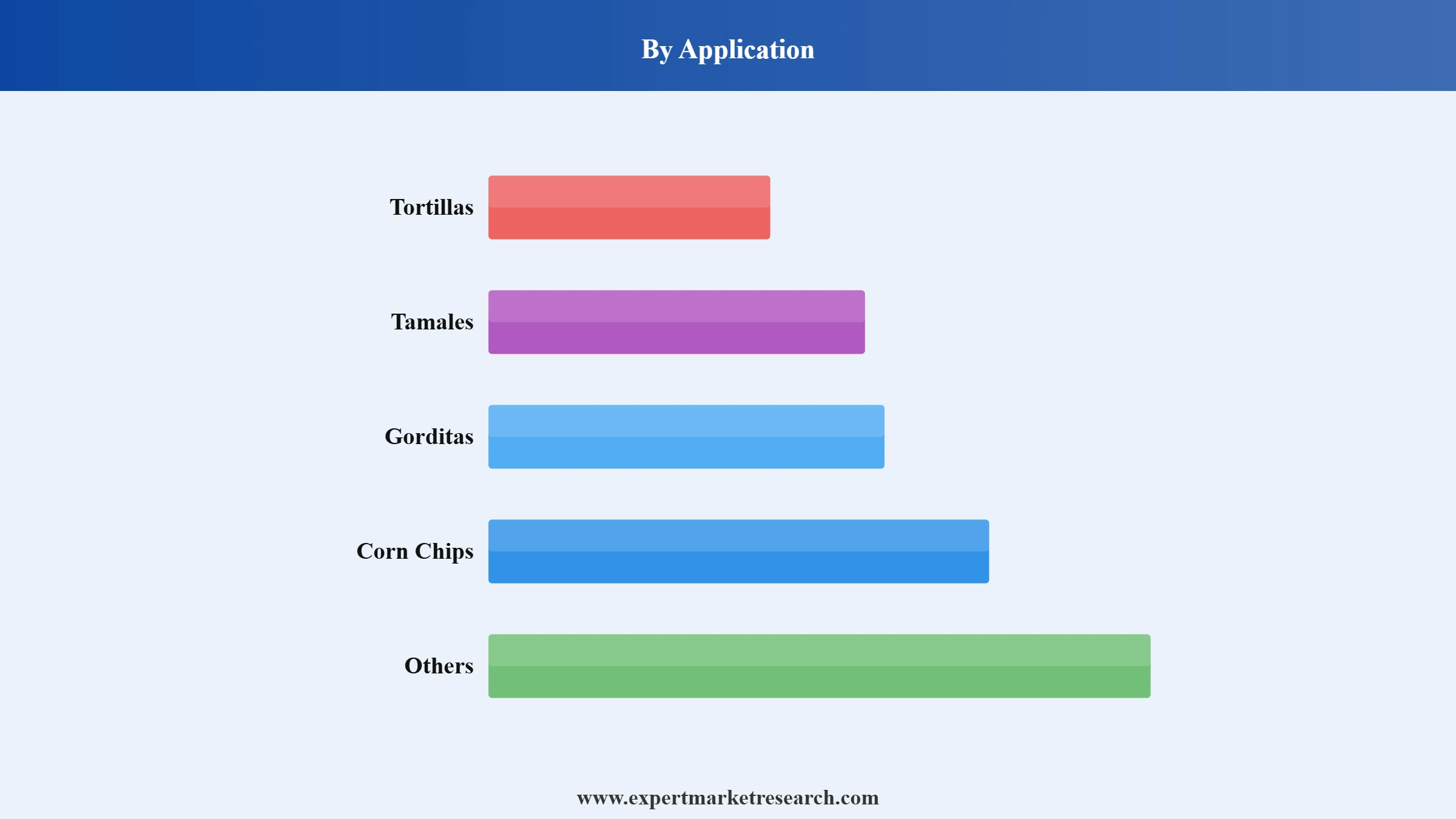
Key Insight: The masa flour market caters to the diversity of applications, such as tortillas, tamales, gorditas, corn chips, and other food items. Tortillas capture the biggest share in terms of demand, whereas the innovation in flavors and formats is observable in corn chips and other snack categories. Leading firms such as Mission Foods and Gruma introduce new products in the market in the form of tortillas, snacks, and ready-to-cook products such as tamales and gorditas, broadening market opportunities.
Market Breakup by End Use
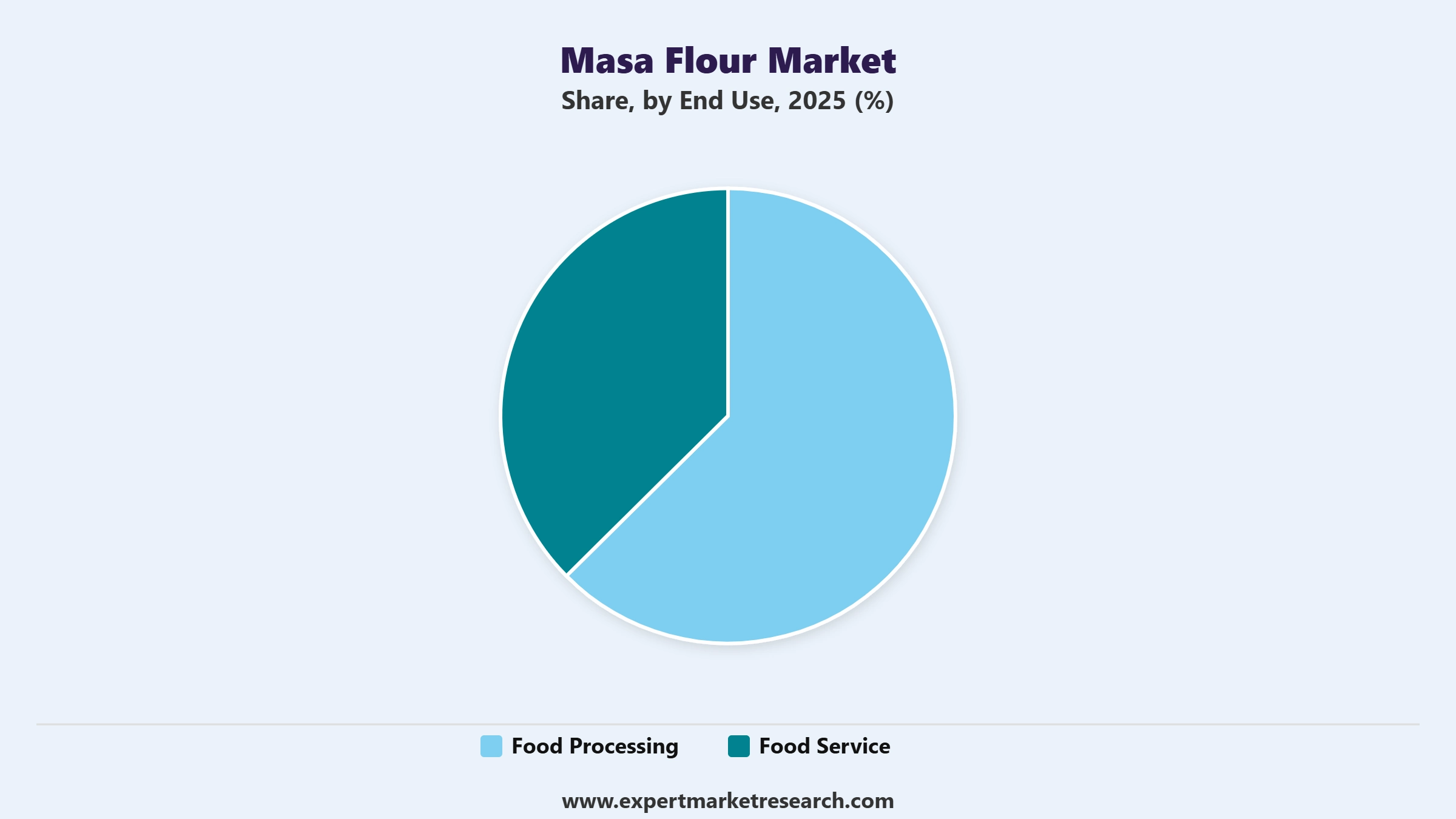
Key Insight: The major end-use categories that generate high revenue in the masa flour market are food processing and food service sectors. Mega-processors rely on packaged masa flour to make packaged tortillas and chips, as well as snacks, and restaurants and fast-food establishments are increasingly using the masa-based products in their menus. Cargill and ADM supply customized formulations to industrial players, artisanal producers, chefs, and specialty outlets. These developments are supporting market growth across both commercial and retail segments by effectively meeting diverse demand.
Market Breakup by Region
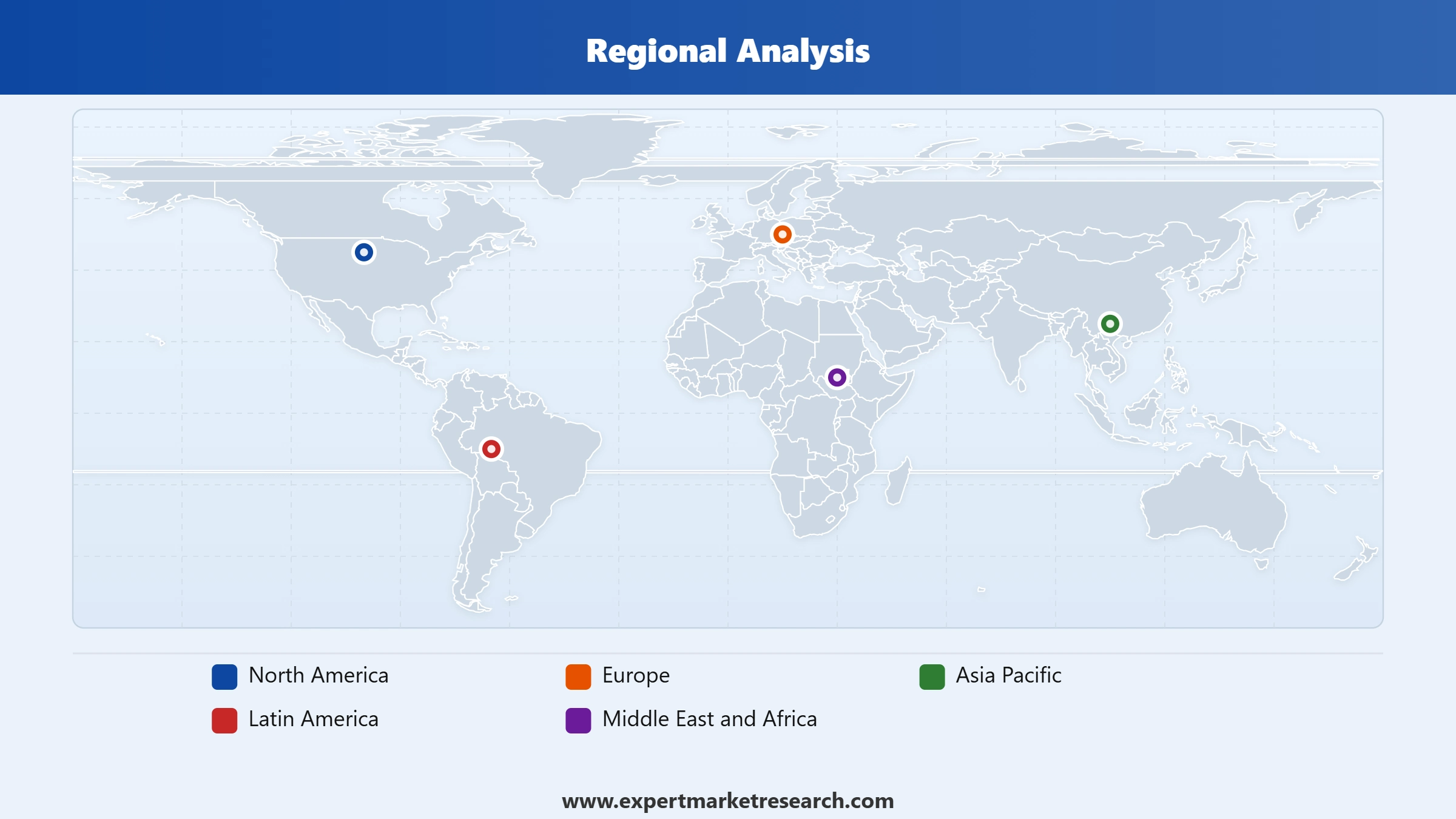
Key Insight: Regionally, the global masa flour market landscape covers North America, Europe, Asia Pacific, Latin America, and the Middle East and Africa, and North and Latin America, which are the key consumers due to strong traditional cuisine demand. Asia Pacific and Europe are emerging to be new growth hubs, powered by the multicultural food trends and online retailing. Companies such as Limagrain Group and Gruma are expanding their regional presence, enabling broader consumer reach and capturing new opportunities in the global market.

Read more about this report - REQUEST FREE SAMPLE COPY IN PDF
By nature, organic masa flour is gaining traction driven by growing preference for organic ingredients
The organic masa flour industry is picking up pace due to the growing consumer awareness of health and sustainability. Manufacturers are emphasizing creating certified organic, non-GMO, and flavorful varieties to satisfy the increased demand for high-quality products. Such initiatives enhance the supply chain, product availability, and product diversification. For example, Just About Foods introduced its Heirloom Organic Blue Corn Masa Flour in September 2025. This is an illustration of how the high-quality organic masa products are trending in the market.
Read more about this report - REQUEST FREE SAMPLE COPY IN PDF
The conventional masa flour market has been able to expand owing to its common use for traditional cooking purposes in the forms of tortillas, tamales, and snacks. The manufacturers are streamlining the production operations in order to have steady quality and supply to both retail and foodservice outlets. Firms such as Maseca (Gruma) are upgrading their traditional products through better grain choices and processing equipment, ensuring consistent quality for large consumer bases and supporting long-term market growth.
By type, yellow mass is in high demand owing to enhanced supply chain and quality assurance
The yellow masa flour market is experiencing tremendous growth as firms are focusing on high-quality products and quality sourcing. Players such as Patel Impex are also investing in multi-stage cleaning, ISO/IEC 17025 laboratory testing, and high-tech moisture control to maintain consistency of purity and performance. The cross-border distribution is facilitated by strategic logistics in the areas of Mundra and Kandla ports, in addition to digital tracking through the ERP system, such as PatelLink. Such initiatives improve product quality and strengthen supply chains, supporting rising demand across industrial and foodservice sectors while driving overall market growth.
Read more about this report - REQUEST FREE SAMPLE COPY IN PDF
Meanwhile, the white type is gaining traction in the masa flour market, driven by the ongoing initiatives that promote domestic sourcing and sustainable agricultural practices. The major players, such as Gruma, are assisting small and medium-sized white corn farmers with technical training on fertilization, pest control, and conservation agriculture. Incorporating small farmers into their supply chains promotes food sovereignty and ensures that businesses maintain a constant level of quality and volume. Their activities benefit the market in addition to increasing yields and operational performance since they establish a safe, sustainable, and scalable production ecosystem.
By distribution channel, supermarkets and hypermarkets amass significant product sales owing to widespread availability of ready-to-eat corn-based products
The consumption of ready-to-eat and convenient corn-based goods found in supermarkets and hypermarkets is driving product sales in the global market. The retail channels provide better visibility and access to the consumers, and strategic partnerships boost the shelf presence and sales potential. For instance, in October 2025, DKSH Taiwan collaborated with Del Monte Asia to introduce the Del Monte ready-to-eat Whole Kernel Corn to the market through supermarkets.
Read more about this report - REQUEST FREE SAMPLE COPY IN PDF
On the other hand, online retail channels are boosting the growth of the masa flour market, with the e-commerce sites and specialty food websites expanding the reach of consumers to fresh and artisanal masa products. To keep up with growing demand in the market, players are promoting direct-to-consumer sales, subscriptions, and fast delivery services to satisfy the growing demand for tortillas, tamales, and other products made from masa. With the help of online marketing and home delivery, the companies become more visible and convenient, which leads to more adoption and a general increase in the market reach.
By application, tortillas witness high demand owing to the rising demand for ready-to-eat and specialties
The industry is observing high demand for application in manufacturing tortillas, with consumers highly demanding convenient, quality, and innovative products in tortillas. Major players are launching value-added tortillas and tortilla-based meals as a way of capturing new consumption events and diversifying their products. For instance, in March 2026, PepsiCo opened its first-ever Lay's restaurant, Pilla Tortilla, in Madrid, Spain, transforming the classic Spanish tortillas into new flavors and ready-to-eat styles. The masa flour market is growing directly due to such initiatives.
Read more about this report - REQUEST FREE SAMPLE COPY IN PDF
With its companies focusing on healthier and more upscale snacks and innovative production techniques to cater to the shifting consumer tastes and preferences, the corn chips applications are expanding. Manufacturers are working on developing low-fat, non-GMO products, trying to improve texture and flavor, and using technology to produce quality, consistent products. The strategies can help not only increase consumer interest but also increase distribution through both conventional and old-fashioned retailers. In February of 2023, 4700BC introduced Corn Chips+, a 100% non-GMO, low-fat product that makes the snack category's crunchy choices newly available in India.
By end-use, the food service sector shows robust growth driven by the rising popularity of fresh, artisanal masa flour in restaurants and food halls
The food service end-use category contributes substantially to the masa flour market revenue, with more restaurants and food halls offering freshly made and artisanal masa products. Consumers are demanding authentic, high-quality tortillas, tamales, and antojitos that demonstrate the heritage of the varieties of corn. In September 2024, Komal opened a molino-restaurant in Los Angeles, at Mercado La Paloma, which serves freshly nixtamalized masa and several classic Mexican cuisines. This project will attract local customers while supplying restaurants on a wholesale basis, encouraging broader adoption of high-quality masa in the foodservice sector.
Read more about this report - REQUEST FREE SAMPLE COPY IN PDF
On the other hand, the food processing industry is experiencing a stable demand for masa flour, with the manufacturers being more willing to use masa in ready-to-eat food, snacks, and frozen food. Companies are expanding on large-scale production lines and focusing on innovations based on masa ingredients to satisfy the increasing demand by consumers for authentic flavors and convenience. Through simplification of processing methods and constant quality, the market players are improving the efficiency and product diversity, thus contributing to the market expansion in commercial and industrial food use.
By region, North America dominates the market owing to the growing artisanal and specialty masa demand
North America is experiencing a surging consumption of the masa flour due to the rising trend towards genuine and quality corn-based products. Specialty cafés and artisanal brands are expanding access to traditional masa for tortillas, tamales, and gorditas, increasing product awareness and adoption. An example is the opening of Café Bolita in Berkeley, California, United States, in March 2026, which serves fresh masa-prepared foods to be consumed at home, as a move towards premium and specialty product consumption that boosts the overall market growth in the area.
Read more about this report - REQUEST FREE SAMPLE COPY IN PDF
Apart from this, Asia Pacific accounts for a significant share of the global masa flour market, with the prominent businesses implementing the best strategies to boost output and distribution. Firms such as Cargill and Wilmar International are adopting new milling technologies and capacity building to enhance the quality and uniformity of their products. In the meantime, Bunge Asia is working with local corn farmers to secure a stable supply chain, and Ajinomoto is providing fortified and specialty masa flour varieties to meet the new demands of consumers.
Key masa flour market players are focusing on technological advancements and optimization of the process as a way of ensuring quality and supply remain steady. Firms, such as Maseca (Gruma) and Patel Impex, are using modern milling processes, quality control measures, and online monitoring of supply chains to simplify operations. These activities boost productivity, minimize wastage, and guarantee stable deliveries to both retail and foodservice segments, which promote the overall market development.
Major masa flour companies are also diversifying product portfolios and are consolidating regional sourcing networks to meet the increasing consumer demand. Local corn production, farmer training programs, and well-developed logistics networks enable companies to secure high-quality raw materials and expand distribution reach. These measures assist the players in scaling up the production, being cost-effective, and strengthening their hold in the competitive landscape of the market.
Cargill, Incorporated, is a food and agriculture company with headquarters in Wayzata, Minnesota, Unted States, that was established in 1865. The company is also in the business of sourcing, processing, and distributing agricultural commodities such as corn products that are part of the masa flour market.
Buhler AG is an innovative processing solution for grains and pulses, with its headquarters situated in Uzwil, Switzerland, and was established in 1860. Its modern milling processes are widely used in the process of high-quality masa flour production for the international markets.
Limagrain Group is a French cooperative group established in the year 1965 with its headquarters at Clermont-Ferrand, France. The company specializes in seed and cereal-based products, and it also provides maize varieties that are used to sustain growth in the the masa flour market.
Bob's Red Mill, established in 1978 and located in Milwaukie, Oregon, United States, deals with natural and organic whole grain products. It offers a selection of masa flours that are known to have traditional stone-ground quality, which meets the demands of artisanal and commercial baking.
*Please note that this is only a partial list; the complete list of key players is available in the full report. Additionally, the list of key players can be customized to better suit your needs.*
Explore the latest trends shaping the global masa flour market 2026-2035 with our in-depth report. Gain strategic insights, future forecasts, and key market developments that can help you stay competitive. Download a free sample report or contact our team for customized consultation on global masa flour market trends 2026.


Upto 15% Off
USD
$2499 $2249
$3999 $3599
$4999 $4249
$5999 $5099


*While we strive to always give you current and accurate information, the numbers depicted on the website are indicative and may differ from the actual numbers in the main report. At Expert Market Research, we aim to bring you the latest insights and trends in the market. Using our analyses and forecasts, stakeholders can understand the market dynamics, navigate challenges, and capitalize on opportunities to make data-driven strategic decisions.*
The market is projected to grow at a CAGR of 11.70% between 2026 and 2035.
Key strategies driving the market include product diversification, adoption of advanced milling technologies, strengthening supply chains, farmer partnerships, and expanding distribution networks.
The key trends guiding the growth of the market include the emerging new diets incorporating masa flour and the growing prevalence of gluten-free food items.
The major regions in the market are North America, Latin America, the Middle East and Africa, Europe, and the Asia Pacific.
The various natures of masa flour in the market are organic and conventional.
The significant types of masa flour in the market are yellow and white.
The major distribution channels of masa flour are supermarket and hypermarket, convenience stores, specialty stores, and online retail, among others.
The significant applications are tortillas, tamales, gorditas, and corn chips, among others.
The major end uses of masa flour are food processing and food service.
The key players in the market include Cargill, Incorporated, Bühler AG, Limagrain Group, and Bob’s Red Mill Natural Foods, among others.
In 2025, the global masa flour market reached an approximate value of USD 1.59 Billion.
The major challenges that the global masa flour market players face includes fluctuating raw material prices, supply chain disruptions, strict quality and safety regulations, and intense competition among established and emerging brands.
Explore our key highlights of the report and gain a concise overview of key findings, trends, and actionable insights that will empower your strategic decisions.
| REPORT FEATURES | DETAILS |
| Base Year | 2025 |
| Historical Period | 2019-2025 |
| Forecast Period | 2026-2035 |
| Scope of the Report |
Historical and Forecast Trends, Industry Drivers and Constraints, Historical and Forecast Market Analysis by Segment:
|
| Breakup by Nature |
|
| Breakup by Type |
|
| Breakup by Distribution Channel |
|
| Breakup by Application |
|
| Breakup by End Use |
|
| Breakup by Region |
|
| Market Dynamics |
|
| Competitive Landscape |
|
| Companies Covered |
|
| Report Price and Purchase Option | Explore our purchase options that are best suited to your resources and industry needs. |
| Delivery Format | Delivered as an attached PDF and Excel through email, with an option of receiving an editable PPT, according to the purchase option. |
Datasheet
One User
USD 2,499
USD 2,249
tax inclusive*
Single User License
One User
USD 3,999
USD 3,599
tax inclusive*
Five User License
Five User
USD 4,999
USD 4,249
tax inclusive*
Corporate License
Unlimited Users
USD 5,999
USD 5,099
tax inclusive*
*Please note that the prices mentioned below are starting prices for each bundle type. Kindly contact our team for further details.*
Flash Bundle
Small Business Bundle
Growth Bundle
Enterprise Bundle
*Please note that the prices mentioned below are starting prices for each bundle type. Kindly contact our team for further details.*
Flash Bundle
Number of Reports: 3
20%
tax inclusive*
Small Business Bundle
Number of Reports: 5
25%
tax inclusive*
Growth Bundle
Number of Reports: 8
30%
tax inclusive*
Enterprise Bundle
Number of Reports: 10
35%
tax inclusive*
How To Order

Select License Type
Choose the right license for your needs and access rights.

Click on ‘Buy Now’
Add the report to your cart with one click and proceed to register.

Select Mode of Payment
Choose a payment option for a secure checkout. You will be redirected accordingly.
Strategic Solutions for Informed Decision-Making
Gain insights to stay ahead and seize opportunities.

Get insights & trends for a competitive edge.

Track prices with detailed trend reports.

Analyse trade data for supply chain insights.

Leverage cost reports for smart savings

Enhance supply chain with partnerships.

Connect For More Information
Our expert team of analysts will offer full support and resolve any queries regarding the report, before and after the purchase.
Our expert team of analysts will offer full support and resolve any queries regarding the report, before and after the purchase.
We employ meticulous research methods, blending advanced analytics and expert insights to deliver accurate, actionable industry intelligence, staying ahead of competitors.
Our skilled analysts offer unparalleled competitive advantage with detailed insights on current and emerging markets, ensuring your strategic edge.
We offer an in-depth yet simplified presentation of industry insights and analysis to meet your specific requirements effectively.




