

Consumer Insights
Uncover trends and behaviors shaping consumer choices today
Procurement Insights
Optimize your sourcing strategy with key market data
Industry Stats
Stay ahead with the latest trends and market analysis.
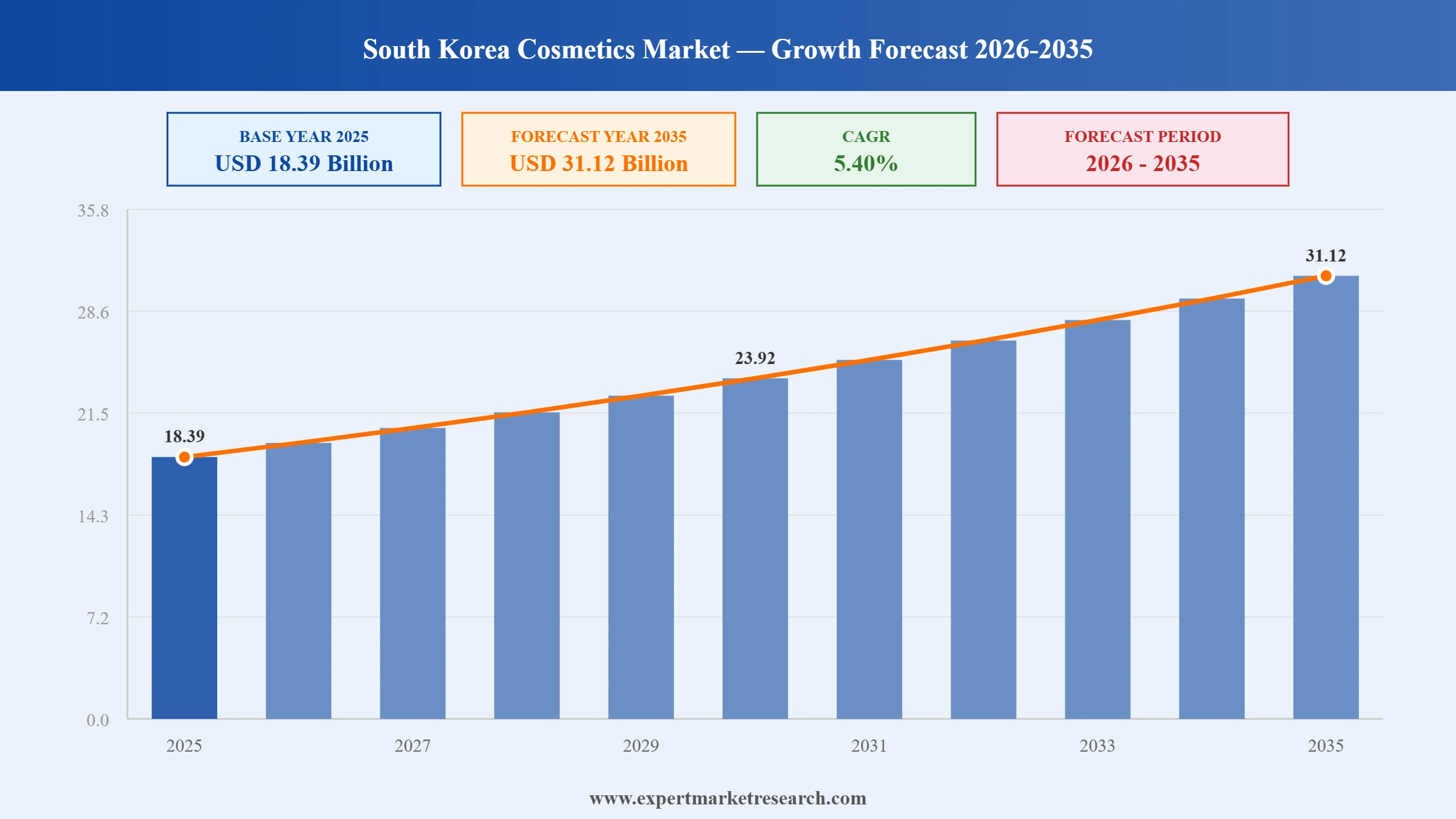
The South Korea cosmetics market reached a value of USD 18.39 Billion at 2025 and is projected to expand at a CAGR of around 5.40% during the forecast period of 2026-2035. With the global expansion of K-beauty as a benchmark skincare and cosmetics standard, rising demand for functional and clean-label formulations, accelerating online and specialty channel adoption, and the convergence of beauty technology with AI-powered personalization, the market is expected to reach USD 31.12 Billion by 2035.

Read more about this report - REQUEST FREE SAMPLE COPY IN PDF
| South Korea Cosmetic Market Report Summary | Description | Value |
| Base Year | USD Billion | 2025 |
| Historical Period | USD Billion | 2019-2025 |
| Forecast Period | USD Billion | 2026-2035 |
| Market Size 2025 | USD Billion | 18.39 |
| Market Size 2035 | USD Billion | 31.12 |
| CAGR 2019-2025 | Percentage | XX% |
| CAGR 2026-2035 | Percentage | 5.40% |
| CAGR 2026-2035 - Market by Gender | Female | 6.2% |
| CAGR 2026-2035 - Market by Distribution Channels | Online | 11.5% |
| Market Share 2025- Market by Gender Type | Female | 71.3% |
South Korea's cosmetics market continues to set global standards for skincare innovation, digital-first retail, and K-beauty product development. Domestic conglomerates are scaling internationally while global majors acquire Korean manufacturing expertise and brands. AI-powered beauty technology, growing male grooming adoption, and expanding specialty store and online channel penetration are collectively sustaining strong growth momentum across the South Korea cosmetics market.
In February 2026, Amorepacific Group reported record consolidated revenue of KRW 4.62 trillion for the full year 2025, with its overseas business delivering 15% revenue growth and 102% operating profit growth year-on-year. This exceptional performance validated K-beauty's global commercial momentum and confirmed Amorepacific's position as the flagship enterprise of the South Korea cosmetics market on both domestic and international fronts.
In February 2025, L'Oreal acquired the South Korean division of Mibelle Group, gaining access to domestic manufacturing expertise and rapid product development capabilities. This acquisition highlighted the strategic value that global cosmetics corporations place on Korean formulation know-how and reinforced South Korea's position as a global contract manufacturing hub, directly stimulating further international investment into the South Korea cosmetics market.
In January 2025 at CES in Las Vegas, Amorepacific was named a CES 2025 Innovation Award Honoree for its generative AI-based makeup application WANNA-BEAUTY AI, marking the company's sixth consecutive CES Innovation Award. The voice-activated application uses facial analysis, AI trained by makeup artists, and virtual try-on technology, reinforcing Amorepacific's position as a global beauty technology leader within the South Korea cosmetics market.
In November 2024, APR Corp reported its Q3 2024 results, revealing that cumulative overseas sales of its medicube AGE-R beauty devices had surpassed 1 million units, accounting for over 40% of total device sales, more than doubling year-on-year. The results confirmed APR's strong expansion across Japan and Chinese-speaking markets, underscoring the South Korea cosmetics market's growing global export strength through technology-led beauty devices.
Skin care is the anchor of the South Korea cosmetics market, driven by the globally influential K-beauty multi-step skincare culture that emphasises cleansing, toning, essence, serum, and moisturising routines. Korean dermocosmetics brands export to over 150 countries, with South Korea becoming the fourth-largest cosmetics exporter globally by 2023. Functional formulations targeting anti-aging, brightening, and barrier repair continue to set new international product development benchmarks.
Online distribution is driving the fastest channel growth within the South Korea cosmetics market, supported by approximately 98 percent internet penetration, Coupang's same-day delivery infrastructure, and Naver's integrated social commerce discovery ecosystem. APR Corp's KRW 100 billion overseas online revenue in Q3 2024 validates digital-first go-to-market strategies, while influencer-led beauty content on social platforms continues to accelerate product discovery and trial among both domestic and international consumers.
South Korea cosmetics market growth is increasingly shaped by global beauty majors acquiring Korean brands and manufacturing capabilities to access K-beauty formulation expertise. Amorepacific's acquisition of COSRX, alongside L'Oreal's acquisition of Mibelle Group's South Korean division in February 2025, exemplify how strategic M&A activity is consolidating premium Korean skincare brands within global conglomerate portfolios while preserving their distinct K-beauty identity.
The male consumer segment within the South Korea cosmetics market is growing as cultural acceptance of male beauty routines broadens and brands launch targeted skincare, colour cosmetics, and hair care lines for men. This shift aligns with the broader K-beauty cultural export that normalises comprehensive personal grooming for all genders. Domestic players including Amorepacific and LG H&H are actively extending male-specific product ranges to capture this expanding consumer demographic.
Specialty stores and pharmacies remain important offline distribution pillars within the South Korea cosmetics market, providing consumers with expert-guided product selection and access to dermatologist-recommended formulations. Health and beauty stores held 54.10% of the market share in 2025, reflecting South Korea's preference for experiential retail environments where consumers can test, compare, and receive personalised skincare advice before purchasing colour cosmetics, serums, and dermocosmetics products.
The Expert Market Research’s report titled “South Korea Cosmetics Market Report and Forecast 2026-2035” offers a detailed analysis of the market based on the following segments:
Market Breakup by Category
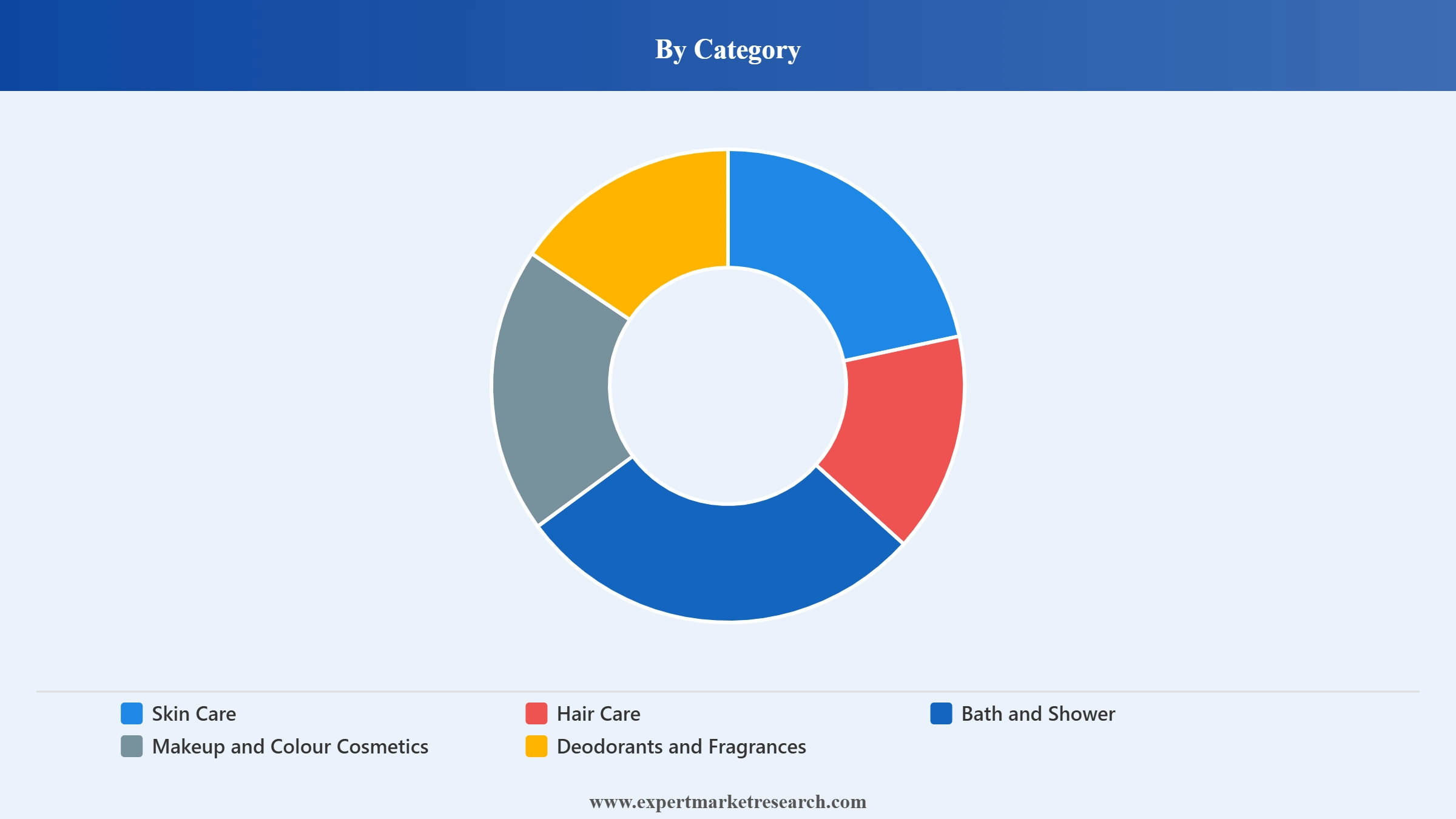
Key Insight: Skin care dominates the South Korea cosmetics market by category, anchored by the K-beauty multi-step skincare routine that drives high per capita spending on essences, serums, and functional face care formulations. Makeup and colour cosmetics are growing as K-pop and K-drama drive aspirational beauty trends among younger consumers. Hair care benefits from premium product launches and the growing male grooming segment. Bath and shower products are expanding as consumers trade up from commodity formats to premium, fragrant, and skin-benefit-led formulations.
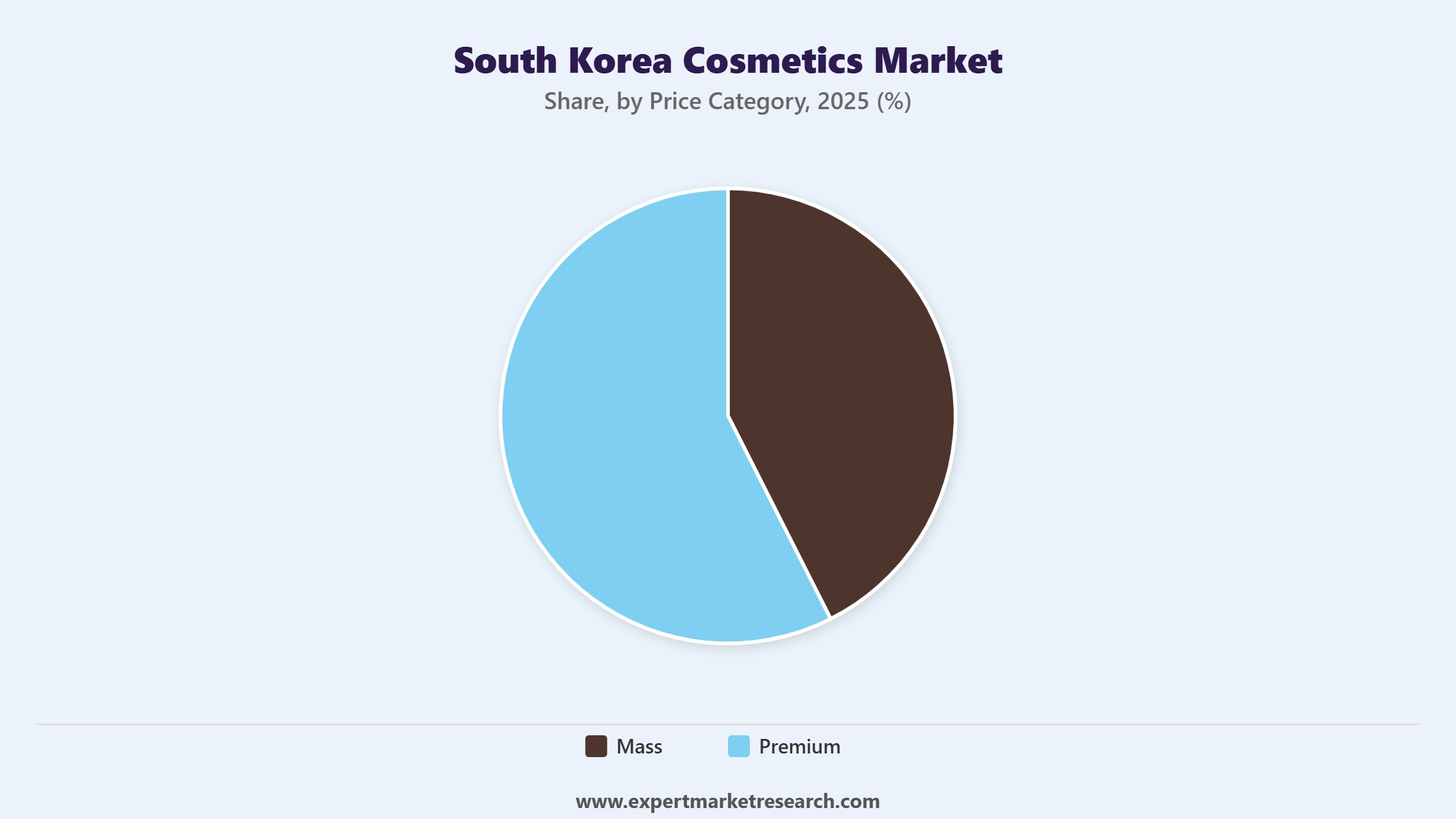
Market Breakup by Price Category
Key Insight: Mass cosmetics hold the dominant volume share within the South Korea cosmetics market, supported by a deep domestic manufacturing base of contract manufacturers including Cosmax and Kolmar Korea that enable high-quality, affordable product development across all brand tiers. The premium segment is growing at a faster rate, driven by rising disposable incomes, K-beauty's globally reinforced prestige positioning, and consumer willingness to pay for scientifically validated formulations, clean-label ingredients, and luxury sensory experiences in both skincare and colour cosmetics.
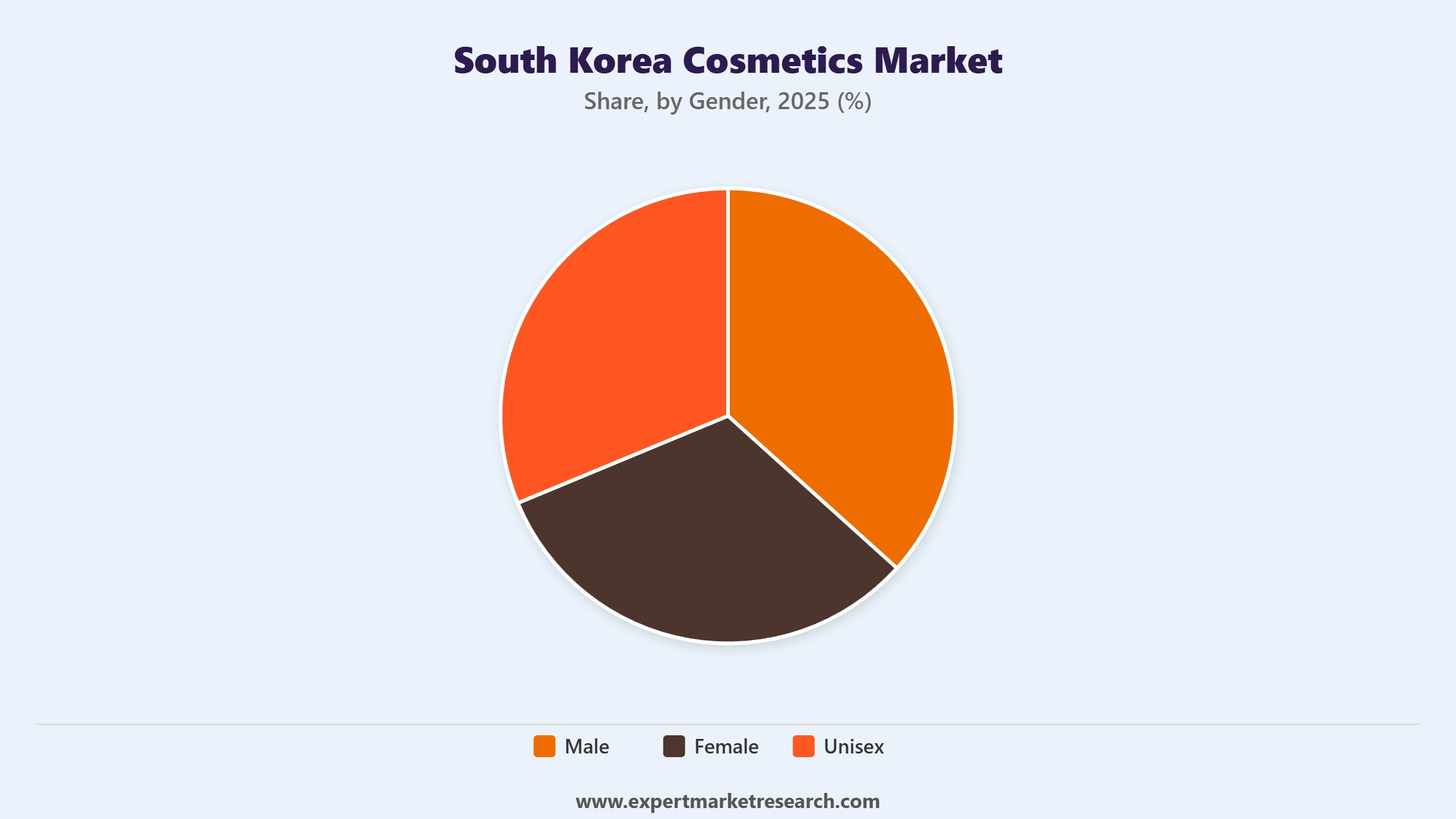
Market Breakup by Gender
Key Insight: Female consumers account for the dominant share within the South Korea cosmetics market, historically driving demand across skincare, colour cosmetics, hair care, and fragrance categories. The male segment is growing as Korean cultural norms around personal grooming evolve and K-beauty influence normalises dedicated male skincare and colour product use. Unisex formulations are gaining ground, particularly in skincare essentials, sunscreen, and tinted moisturisers, reflecting broader consumer movement toward gender-neutral beauty propositions across the South Korea cosmetics market.
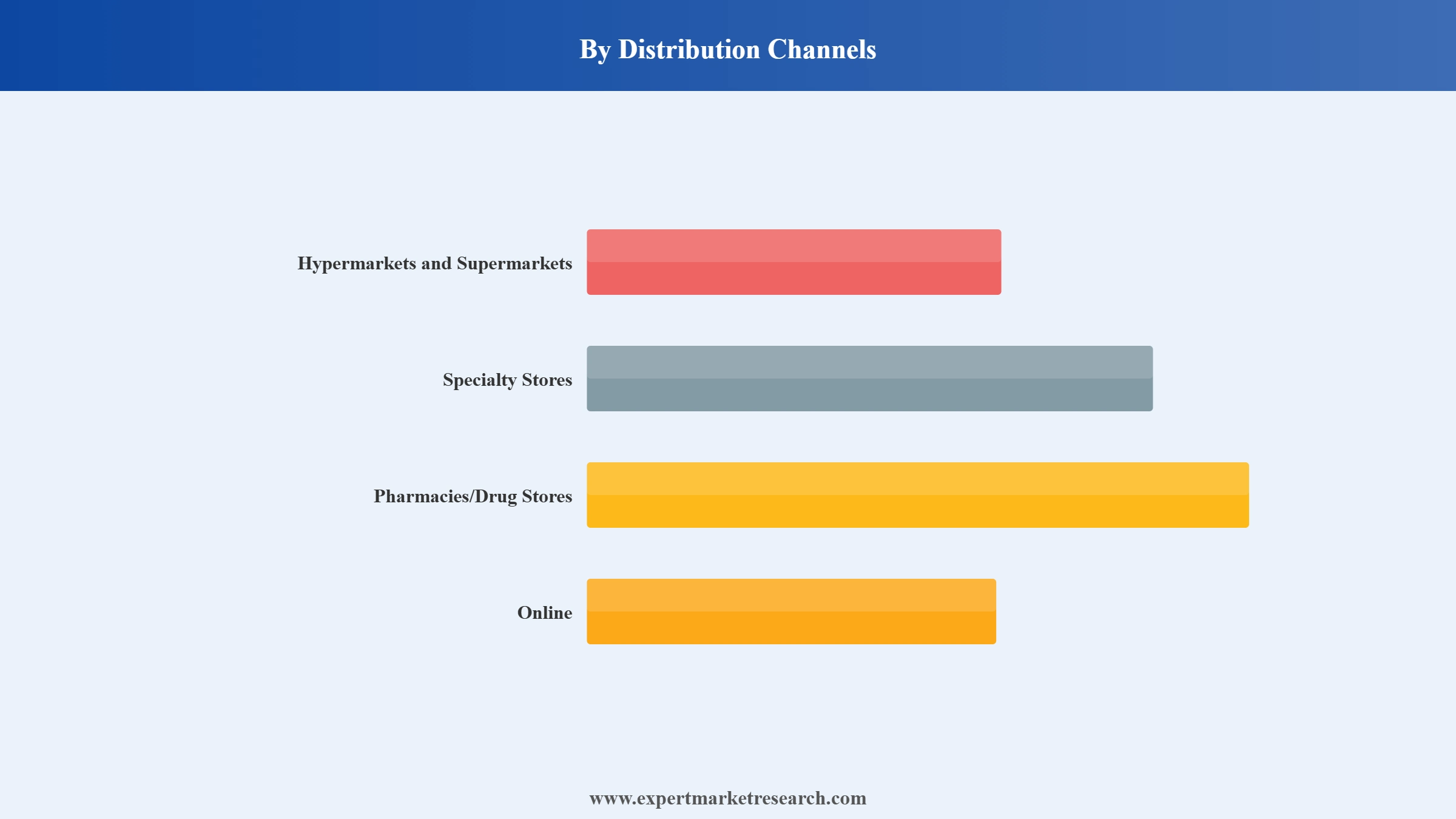
Market Breakup by Distribution Channels
Key Insight: Specialty stores hold the largest share of offline distribution within the South Korea cosmetics market, providing immersive brand experiences, tester access, and consultative selling that higher-value cosmetics purchases require. Online is the fastest-growing channel, predicted to post a 7.12% CAGR over the forecast period, supported by social commerce, influencer-led discovery, and e-commerce platform convenience. Pharmacies and drug stores are growing as consumers seek dermatologist-recommended and clinically validated cosmetics, aligning with the broader premiumisation and functional beauty trend across the South Korea cosmetics market.
Read more about this report - REQUEST FREE SAMPLE COPY IN PDF
By category, skin care accounts for the dominant share of the market due to K-beauty multi-step routine culture
Skin care holds the largest category share within the South Korea cosmetics market because the K-beauty multi-step routine, encompassing cleansers, toners, essences, serums, sheet masks, eye creams, and moisturisers, drives high per-consumer spending absent in other cosmetic categories. South Korea became the fourth-largest cosmetics exporter globally by 2023, according to the International Trade Administration, with skin care formulations constituting the bulk of export value. Functional dermocosmetics targeting anti-aging, brightening, and skin-barrier repair sustain both domestic and international demand.
Makeup and colour cosmetics represent a growing category within the South Korea cosmetics market, propelled by the global influence of K-pop idol beauty aesthetics and K-drama styling that sets international colour trends. Amorepacific's six consecutive CES Innovation Awards reflect how domestic cosmetics leaders invest heavily in technology-driven differentiation, including AI-powered robot foundation matching covering over 100 shades deployed in 2025 to deliver precision-matched, inclusive colour cosmetics experiences to Korean consumers.
Read more about this report - REQUEST FREE SAMPLE COPY IN PDF
By price category, mass cosmetics account for the dominant share of the market due to domestic manufacturing depth and affordability
Mass cosmetics hold the dominant volume share within the South Korea cosmetics market, supported by one of the world's most efficient cosmetics contract manufacturing ecosystems. Cosmax and Kolmar Korea enable domestic and international brands to produce high-quality formulations at competitive price points, making premium-quality mass cosmetics broadly accessible. This deep manufacturing base sustains a highly competitive mass cosmetics landscape where brands differentiate on ingredient innovation and marketing rather than production cost alone.
Premium cosmetics are growing at a faster pace within the South Korea cosmetics market, driven by rising household incomes, K-beauty's prestige global positioning, and consumer appetite for scientifically backed, clean-label, and results-oriented formulations. Amorepacific's record KRW 4.62 trillion revenue for 2025, reported in February 2026, with overseas business contributing 15% revenue growth and 102% operating profit growth, reflects how premium K-beauty positioning translates into measurable financial outperformance both domestically and internationally.
Read more about this report - REQUEST FREE SAMPLE COPY IN PDF
By gender, female consumers account for the dominant share of the market due to historically higher engagement across all beauty categories
Female consumers hold the dominant share within the South Korea cosmetics market, driven by historically higher engagement with skincare routines, colour cosmetics, hair care, and fragrance across all product tiers. The K-beauty culture, which places skincare at the centre of daily wellness and self-expression, has been shaped primarily around female consumers who embrace multi-step routines and are early adopters of new formulations and technologies. Chanel Korea's 8.2% sales growth to KRW 1.84 trillion in 2024 and Amorepacific's flagship Sulwhasoo and Laneige brands both draw the majority of their revenue from female consumers who prioritise science-backed, premium skincare experiences.
The male segment is the fastest-growing gender category within the South Korea cosmetics market, expanding as cultural acceptance of male beauty routines broadens and leading brands introduce targeted skincare and colour lines specifically for men. South Korea's K-pop idol culture has normalised comprehensive grooming among younger male consumers, and brands including LG H&H and Amorepacific have extended dedicated male product portfolios to capture this demographic. In January 2025, Amorepacific's CES Innovation Award for WANNA-BEAUTY AI, which supports inclusive personalised beauty across all consumers, reflects how technology-driven cosmetics engagement is expanding the market's reach beyond traditional female-focused audiences.
Read more about this report - REQUEST FREE SAMPLE COPY IN PDF
By distribution channels, specialty stores account for the dominant share of the market due to experiential retail and expert-led product selection
Specialty stores hold the largest offline distribution share within the South Korea cosmetics market because Korean consumers value the ability to test formulations, receive skin consultations, and compare products across brands before purchasing. Health and beauty stores accounted for 54.10% of the market share in 2025, reflecting a retail culture that prioritises in-store expertise and sensory engagement. Dedicated K-beauty specialty store chains including Innisfree, Etude House, and Olive Young serve as primary retail destinations for both domestic shoppers and international beauty tourists in Seoul and other cities.
Online is the fastest-growing distribution channel within the South Korea cosmetics market, predicted to post a 7.12% CAGR over the forecast period. Coupang's same-day delivery service, Naver's integrated social commerce, and the growing role of beauty influencers across Instagram, YouTube, and TikTok have converted digital discovery into high purchase intent among South Korea's younger beauty consumers. APR Corp's 78.6% year-on-year overseas online sales growth in Q3 2024 validates digital-first distribution as a commercially powerful strategy in the evolving South Korea cosmetics market.
Read more about this report - REQUEST FREE SAMPLE COPY IN PDF
The South Korea cosmetics market is anchored by two dominant domestic conglomerates, Amorepacific Corporation and LG Household and Health Co., Ltd., which together command substantial domestic market share across skincare, hair care, colour cosmetics, and personal care categories. The competitive landscape also includes globally active multinational companies such as Procter and Gamble, alongside agile domestic players like ABLE C&C and Korendy Cosmetics that compete in targeted skincare and makeup niches.
The market is characterised by intense innovation cycles, rapid product turnover, and technology-driven differentiation. Contract manufacturers Cosmax and Kolmar Korea support brand-agnostic product development that enables both large conglomerates and indie brands to compete on equal manufacturing terms. Key competitive priorities include AI-powered personalisation, K-beauty export channel development, clean-label formulation investment, and celebrity and influencer partnership strategies targeting both domestic and international markets.
Founded in 1945 and headquartered in Seoul, South Korea, Amorepacific is the country's largest cosmetics conglomerate, operating brands including Sulwhasoo, Laneige, COSRX, Etude, and Innisfree. In February 2026, the group reported record revenue of KRW 4.62 trillion for 2025, with overseas business delivering 102% operating profit growth year-on-year. Its AI-powered robot foundation matching system and six CES Innovation Awards highlight technology leadership within the South Korea cosmetics market.
Founded in 1947 and headquartered in Seoul, South Korea, LG H&H is the second-largest domestic cosmetics company, operating The History of Whoo, O HUI, and Elastine brands. It competes across premium skincare, luxury cosmetics, and personal care categories, with a strong focus on luxury anti-aging skincare lines that command premium pricing in Chinese and Southeast Asian export markets. LG H&H leverages its parent conglomerate's research infrastructure to maintain formulation innovation across the South Korea cosmetics market.
Founded in 1837 and headquartered in Cincinnati, Ohio, Procter and Gamble operates a broad personal care and beauty portfolio in South Korea, including SK-II, Head and Shoulders, Pantene, and Olay. The company competes across the mass and premium tiers of the South Korea cosmetics market, leveraging global R&D capabilities and established retail distribution networks. Its premium skincare brand SK-II commands loyal consumer followings in South Korea's affluent beauty consumer segment.
Founded in 1996 and headquartered in Seoul, South Korea, ABLE C&C operates the Missha and A'Pieu brands, targeting mass-to-mid-range skincare and colour cosmetics consumers. The company pioneered Korea's affordable premium beauty movement and continues to compete in specialty store and online channels across both domestic and export markets. ABLE C&C's agile product development and accessible price positioning make it a consistent competitor within the South Korea cosmetics market for younger, value-conscious beauty consumers.
Other key players in the market are Korendy Cosmetics Inc. and others.
*Please note that this is only a partial list; the complete list of key players is available in the full report. Additionally, the list of key players can be customized to better suit your needs.*
The South Korea cosmetics market faces intensifying competitive and operational challenges driven by domestic market saturation, fast product cycle expectations, and a proliferating counterfeit cosmetics problem. The Korea Customs Service uncovered over 22,000 fake Korean skincare items at Incheon Airport in December 2025 alone, imitating premium brands including Sulwhasoo and d'Alba, directly eroding brand equity and consumer trust. Continuous R&D investment pressure, driven by South Korea's trend-setting beauty culture and highly discerning consumer base, places significant cost burden on both domestic conglomerates and indie brands seeking to sustain relevance across skincare, colour cosmetics, and functional formulation segments.
Structural restraints moderate domestic market expansion despite strong export performance. South Korea's declining birth rate and contracting younger demographic base create a long-term volume challenge in a market where the MZ generation drives the highest per capita beauty spending. Regulatory compliance complexity under the Ministry of Food and Drug Safety covering ingredient restrictions, functional cosmetics licensing, and mandatory safety protocols adds significant time-to-market and cost burden for smaller brands and foreign entrants. Supply chain input cost inflation and dependence on imported raw materials further compress manufacturer margins in an intensely price-competitive domestic environment.
Despite these headwinds, the South Korea cosmetics market presents compelling growth opportunities through the forecast period. The online distribution channel is projected to grow at a CAGR of 7.12%, outpacing the overall market, driven by 98% internet penetration and accelerating social commerce adoption on platforms including Coupang and Naver. Amorepacific's record KRW 4.62 trillion revenue for 2025 with overseas operating profit growing 102% year-on-year validates K-beauty's expanding global commercial momentum. Rising male grooming, premiumisation of functional and dermocosmetics, and AI-powered personalised beauty solutions represent high-value growth vectors analysed in granular detail across segment, channel, and regional dimensions in the full Expert Market Research South Korea Cosmetics Market report.
Get the full picture on the South Korea cosmetics market with our in-depth report. Explore how K-beauty's global influence, AI-powered personalisation, premium skin care innovation, and accelerating online distribution are reshaping competitive dynamics across every category. Whether you formulate cosmetics, operate retail or e-commerce channels, manage brand partnerships, or invest in the beauty sector, this report delivers the intelligence you need. Download your free sample today and discover the key opportunities across cosmetics in South Korea.
India Coconut Oil-Based Cosmetics Market
Asia Pacific Colour Cosmetics Market
Japan Cosmetics Products Market
North America Cosmetics Market
Asia Pacific Cosmetics Market


Upto 15% Off
USD
$2499 $2249
$3999 $3599
$4999 $4249
$5999 $5099


*While we strive to always give you current and accurate information, the numbers depicted on the website are indicative and may differ from the actual numbers in the main report. At Expert Market Research, we aim to bring you the latest insights and trends in the market. Using our analyses and forecasts, stakeholders can understand the market dynamics, navigate challenges, and capitalize on opportunities to make data-driven strategic decisions.*
In 2025, the South Korea cosmetics market reached an approximate value of USD 18.39 Billion.
The market is projected to grow at a CAGR of 5.40% between 2026 and 2035.
The revenue generated from the South Korea cosmetics market is expected to reach USD 31.12 Billion in 2035.
Key strategies driving the market include investing in AI diagnostics, expanding low-MOQ private labels, co-creating export-ready clean beauty lines, integrating omnichannel retail tech, and partnering with biotech labs.
New beauty trends like DIYs, the rising influence of celebrities and the media, and the increasing demand for innovative cosmetic products are the key industry trends.
The products find applications in hair products, lip products, face products, and eye make-up, among others.
Based on distribution channels, the market is divided into hypermarkets and supermarkets, speciality stores, pharmacies/drug stores, online, and others.
The key players are Korendy Cosmetics Inc., Amorepacific Corporation, LG Household and Health Co., Ltd., Procter & Gamble Company, and ABLE C&C, Inc among others.
The market is categorised according to the category, which includes skin care, hair care, bath and shower, makeup and colour cosmetics, deodorants and fragrances, and others.
Based on the price category, the market is divided into mass and premium.
Based on gender, the market is divided into female, male, and unisex.
The key challenges are regulatory complexity and rising raw material costs. Moreover, global competition and counterfeit goods undermine export credibility and squeeze margins across domestic brands.
Explore our key highlights of the report and gain a concise overview of key findings, trends, and actionable insights that will empower your strategic decisions.
| REPORT FEATURES | DETAILS |
| Base Year | 2025 |
| Historical Period | 2019-2025 |
| Forecast Period | 2026-2035 |
| Scope of the Report |
Historical and Forecast Trends, Industry Drivers and Constraints, Historical and Forecast Market Analysis by Segment:
|
| Breakup by Category |
|
| Breakup by Price Category |
|
| Breakup by Gender |
|
| Breakup by Distribution Channels |
|
| Market Dynamics |
|
| Trade Data Analysis |
|
| Competitive Landscape |
|
| Companies Covered |
|
Datasheet
One User
USD 2,499
USD 2,249
tax inclusive*
Single User License
One User
USD 3,999
USD 3,599
tax inclusive*
Five User License
Five User
USD 4,999
USD 4,249
tax inclusive*
Corporate License
Unlimited Users
USD 5,999
USD 5,099
tax inclusive*
*Please note that the prices mentioned below are starting prices for each bundle type. Kindly contact our team for further details.*
Flash Bundle
Small Business Bundle
Growth Bundle
Enterprise Bundle
*Please note that the prices mentioned below are starting prices for each bundle type. Kindly contact our team for further details.*
Flash Bundle
Number of Reports: 3
20%
tax inclusive*
Small Business Bundle
Number of Reports: 5
25%
tax inclusive*
Growth Bundle
Number of Reports: 8
30%
tax inclusive*
Enterprise Bundle
Number of Reports: 10
35%
tax inclusive*
How To Order

Select License Type
Choose the right license for your needs and access rights.

Click on ‘Buy Now’
Add the report to your cart with one click and proceed to register.

Select Mode of Payment
Choose a payment option for a secure checkout. You will be redirected accordingly.
Strategic Solutions for Informed Decision-Making
Gain insights to stay ahead and seize opportunities.

Get insights & trends for a competitive edge.

Track prices with detailed trend reports.

Analyse trade data for supply chain insights.

Leverage cost reports for smart savings

Enhance supply chain with partnerships.

Connect For More Information
Our expert team of analysts will offer full support and resolve any queries regarding the report, before and after the purchase.
Our expert team of analysts will offer full support and resolve any queries regarding the report, before and after the purchase.
We employ meticulous research methods, blending advanced analytics and expert insights to deliver accurate, actionable industry intelligence, staying ahead of competitors.
Our skilled analysts offer unparalleled competitive advantage with detailed insights on current and emerging markets, ensuring your strategic edge.
We offer an in-depth yet simplified presentation of industry insights and analysis to meet your specific requirements effectively.




