

Consumer Insights
Uncover trends and behaviors shaping consumer choices today
Procurement Insights
Optimize your sourcing strategy with key market data
Industry Stats
Stay ahead with the latest trends and market analysis.
The global stadium lighting market attained a value of USD 572.19 Million in 2025 and is projected to expand at a CAGR of 7.40% through 2035. The market is further expected to achieve USD 1168.38 Million by 2035. The increasing aspiration for deeply engaging fan experiences is compelling companies who run stadiums to embrace programmable LED lighting which is not only versatile but can also be synchronized with music and digital displays.
Sports broadcasters have become increasingly insistent on the renovation of lighting systems in the direction of achieving not only evenly illuminated venues but also flicker-free lighting for capturing steady and flawless ultra-high-definition camera shots. Moreover, cities that are hosting international tournaments are dedicating significant portions of their budgets to the refurbishment of stadiums, accelerating the stadium lighting market value.
The global market is gaining new interest as lighting manufacturers are directing their efforts into developing high-performing LED systems for live sports broadcast. In July 2025, FIFA selected Signify as a Preferred Provider for floodlights, recognizing its stadium lighting systems for meeting rigorous performance standards. The system gives stadium managers the ability to adjust the intensity, the sharpness, and the color temperature, all in real-time. According to the stadium lighting market analysis, lighting is responsible for almost 15% of global electricity consumption which is why stadium owners are being compelled to switch their old metal halide floodlights for the more efficient LED ones. Along with the sports venues wanting to reduce the amount of energy used, the lighting manufacturers are also launching lighting platforms that are connected and have long-term cost savings as well as good performance.
Moreover, changes in how stadiums are designed are also influencing the demand in the stadium lighting market dynamics. Nowadays, stadiums are not only sports facilities but rather entertainment complexes that can host concerts, esports tournaments, and multi-sports events. This change is leading developers to opt for a lighting system that can give a broadcast-quality light and at the same time, provide an immersive fan experience. The producers are coming up with modular lighting devices that can be digitally controlled by software. In December 2025, Hero Esports transformed Beijing’s National Stadium for the KPL 2025 Grand Finals, deploying advanced stadium lighting systems to enhance broadcast visibility and spectator experience.
Compound Annual Growth Rate
7.4%
Value in USD Million
2026-2035
Ullevaal Stadium installed a FIFA Quality Pro-certified LED lighting system, improving broadcast clarity, energy efficiency, and match visibility standards. Developments like this create opportunities for companies to deliver certified LED lighting solutions meeting international sports broadcasting and performance standards.
Minnesota Timberwolves unveiled advanced stage lighting at Target Center, enhancing pre-game shows, halftime entertainment, and immersive fan experiences during games. Such developments in the stadium lighting market highlight opportunities for companies to integrate entertainment-focused dynamic lighting solutions that elevate stadium fan engagement and event experiences.
Musco Lighting announced a stadium illumination upgrade at Croke Park, focusing on improved broadcast quality, sustainability, and adaptable lighting control systems. These projects show opportunities for companies to develop energy-efficient stadium lighting systems with smart controls tailored for global sporting venues.
Bajaj Lighting upgraded Wankhede Stadium illumination with advanced sports lighting technology designed to improve visibility, broadcast performance, and spectator experience. Such installations highlight stadium lighting market opportunities for companies to provide high-performance LED lighting tailored for cricket stadiums globally.
Smart lighting platforms are turning into the focus point as per of the global stadium lighting modernization trends. Lighting producers are installing sensors and software that allow users to operate thousands of light fixtures from a central location through digital control dashboards. These systems enable the immediate setting of brightness levels feature adjustments during sports matches, concerts, or ceremonies. Moreover, operators can make lighting pattern changes dependent on the event type without any user intervention, accelerating the entire stadium lighting market dynamics. In February 2026, Deako partnered with Josh.ai to integrate modular smart lighting with AI-powered automation, enabling privacy-focused, voice-controlled lighting systems in AI-ready smart homes.
High, Definition broadcasts have a major impact on the demand for broadcast-ready lighting systems. Sports broadcasting in high-definition and ultra-high-definition formats requires a uniform brightness level across the playing field and a minimum level of light flicker. Manufacturer of lighting fixtures are offering products that are compatible with slow-motion and other advanced video production cameras, reshaping the stadium lighting market trends. In August 2023, Michigan Stadium installed a state-of-the-art LED lighting system for the 2023–24 season, improving field visibility, broadcast quality, and reducing energy consumption.
Various countries are refurbishing their sports facilities to attract international tournaments as well as regional sports competitions. Apart from this, such refurbishing plans also aim at installing modern lighting systems that comply with broadcasting and safety standards, boosting the stadium lighting industry growth. Government-supported infrastructure programs have assisted in upgrading major stadiums by providing them with state-of-the-art LED floodlighting systems. For example, in June 2025, Iberdrola Mexico launched an artistic LED lighting project at Saltillo’s Santiago Cathedral, enhancing architectural visibility while reducing energy consumption and carbon footprint.
Energy conservation is an important aspect that stadium lighting manufacturers are focusing on. Modern LED floodlights use much less power as compared to the metal halide ones, at the same time, producing more illumination. Firms are coming up with high-output LED fixtures that can effectively light up a large stadium with fewer luminaires, driving demand in the stadium lighting market. In March 2026, Signify launched the “Brighter Lives, Better World 2030” sustainability program promoting energy-efficient, circular lighting solutions that reduce emissions and improve quality of life. Moreover, these lighting fixtures feature sophisticated heat dissipation mechanisms that help in prolonging the time that they can be used effectively.
Stadium lighting plays a huge role in the fan entertainment experience. Programmable LED lighting enables venues to produce arranged light shows during team introductions, halftime performances, and post-match celebrations. In many upgraded stadium projects, lighting systems are combined with event control software that oversees visual effects throughout the entire venue, accelerating the stadium lighting market penetration. In December 2025, Rhode Island FC introduced synchronized stadium lighting integrated with mobile technology, enabling immersive light shows that boost fan engagement and interactive matchday experiences.
Read more about this report - REQUEST FREE SAMPLE COPY IN PDF
The EMR’s report titled “Global Stadium Lighting Market Report and Forecast 2026-2035” offers a detailed analysis of the market based on the following segments:
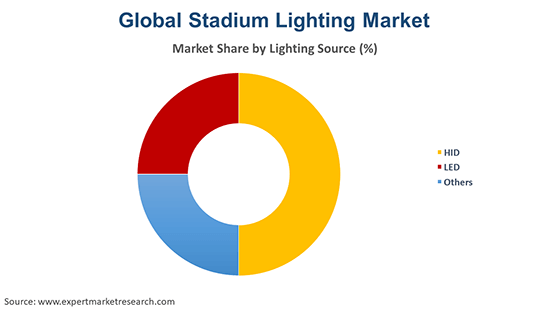
Market Breakup by Lighting Source
Key Insight: LED lighting currently leads the stadium lighting market growth due to its energy-saving capabilities, rapid lighting response, and the exact brightness level control necessary for live sports telecasting. While HID lighting is still installed in older stadiums where infrastructure upgrades have not yet occurred, many long-established stadium operators are now considering replacing these systems with LED luminaires. Other categories include combination lighting technologies and sophisticated optical solutions that emphasize more accurate beam control and the creation of spectacular visual effects.
Market Breakup by Region
Key Insight: Asia Pacific leads growth in the overall global stadium lighting market revenue as governments and sports authorities continue investing in modern stadium infrastructure. North America maintains steady demand due to upgrades in professional sports arenas and entertainment venues. Europe focuses strongly on broadcast-grade lighting systems required for international football competitions. Latin America shows gradual adoption as stadiums modernize to host regional tournaments and concerts. The Middle East and Africa region is expanding rapidly with large-scale stadium construction projects connected to global sporting events and tourism development strategies.
LED lighting account for the dominant share of stadium installations due to energy savings and broadcast compatibility
LED lighting continues to dominate the stadium lighting market scope as venue operators are gradually discarding their old floodlights for the efficient ones. LED luminaires rank top in terms of higher brightness control, lower power consumption, and durability. Sports facility managers opt for LED systems as they reduce operational cost and maintenance interruptions Moreover, major companies like Signify N.V. are launching stadium LED systems designed for accurate beam control and to offer broadcast-quality illumination. On the other hand, in June 2025, Bajaj Lighting upgraded Maharashtra Cricket Association Stadium in Pune, India, with next-generation LED floodlighting, enhancing match visibility, broadcast quality, and energy efficiency.
HID lighting represents a selective category in the stadium lighting market, especially for venues that are upgrading infrastructures that are not very new. Many stadium operators continue to rely on high-intensity discharge floodlights as their existing mounting systems and electrical layouts were originally designed for HID fixtures. Moreover, changing them entirely to new technologies might necessitate major structural modifications. Hence, manufacturers of lightings are coming up with improved HID systems with better reflectors and higher luminous output.
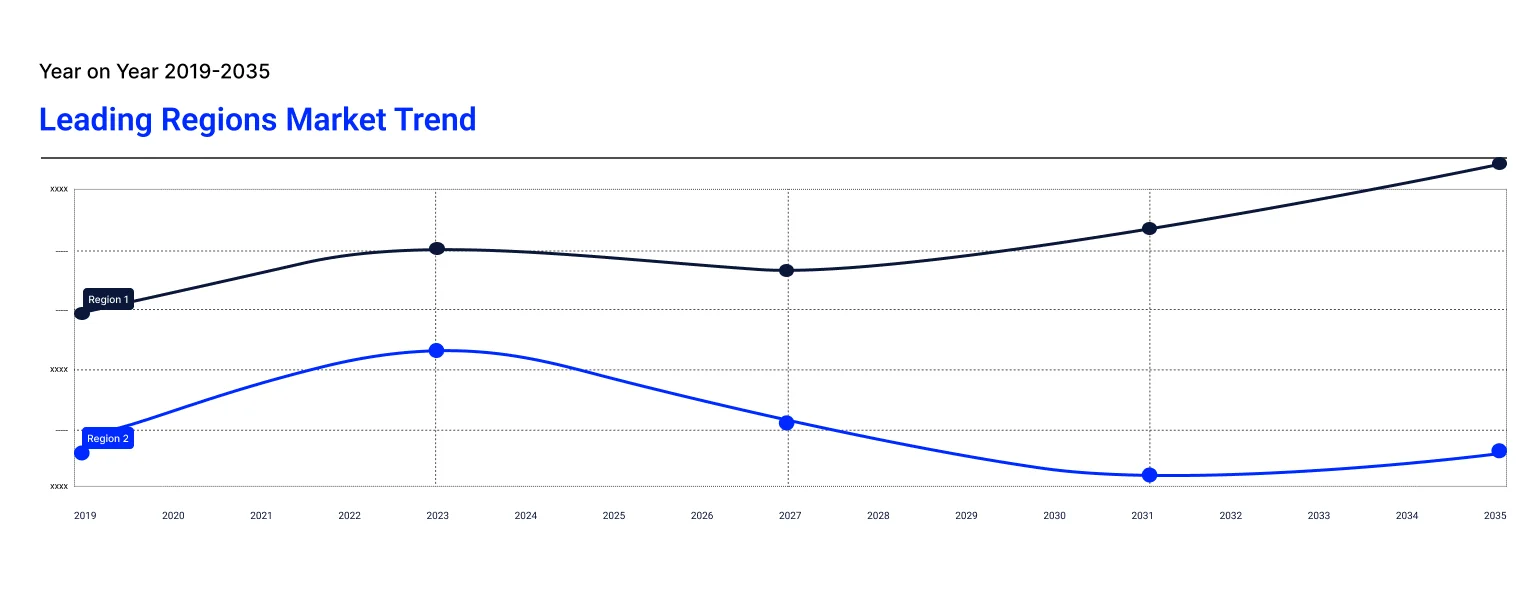
Asia Pacific clocks in the largest market share supported by rapid stadium modernization projects
Asia Pacific represents the largest stadium lighting market, owing to the rise in investments in sports infrastructure and stadium modernization. India, China, Japan, and other countries are gearing up for international events by upgrading their sports venues. Besides, stadium redevelopment projects are being funded by governments and private investors who are looking for modern LED lighting systems. For instance, the government of India has been upgrading infrastructure that includes the provision of high-performance LED floodlights in prominent cricket stadiums. Holkar Stadium in Indore, India, upgraded floodlights with energy-efficient LED systems, improving brightness, instant illumination, and enabling dynamic light shows in October 2025.
Many countries under the North America stadium lighting market are making substantial investments in sports infrastructure to increase tourism and host international events. New stadium construction is usually accompanied by sophisticated lighting systems which meet global broadcast standards. Governments give priority to energy-efficient lighting technology while designing modern stadiums. Major sports venues for international tournaments have been equipped with programmable LED floodlights that can create immersive visual effects. In December 2025, Access Fixtures introduced its 2026 LED sports lighting lineup, featuring high-efficiency, glare-controlled fixtures designed for stadiums, arenas, and large sports venues.
Competition in the market mainly revolves around technological innovation and huge infrastructure contracts. Stadium lighting market players are concentrating on LED floodlights that are ideal for broadcasting high-definition sports and immersive entertainment experiences. Additionally, companies are developing connected lighting systems that enable stadium managers to control brightness levels and color effects using centralized software platforms.
Stadium lighting companies are also offering lighting systems that lessen electricity consumption, while keeping the lighting levels strong throughout large venues. Manufacturers are investing in sophisticated optics and thermal management technologies to enhance fixture performance. It has also become common for lighting companies to form partnerships with stadium developers and sports authorities. Through these collaborations, lighting companies are able to secure long-term contracts that include installation, monitoring, and maintenance services.
Established in 1976, Musco Sports Lighting LLC operates from its headquarters in Oskaloosa, Iowa, United States. The company is a manufacturer of large-scale LED lighting systems for stadiums and other sports facilities worldwide. It offers a comprehensive range of lighting systems, and its TEC for LED lighting solutions helps sports venues deliver illumination that meets broadcasting standards while improving energy efficiency.
Signify N.V. is a global leader in lighting solutions. Founded in 1961 with headquarters located in Netherlands, the company develops advanced LED-based stadium lighting systems through prominent brands such as Philips and Interact. The company focuses on smart lighting management technologies, energy-efficient luminaires, and digital lighting platforms.
Founded in 1950 and based in Austria, Zumtobel Group AG offers professional lighting systems and LED luminaires that are used in large-scale infrastructure projects such as sports halls and entertainment venues. Its product range highlights architectural lighting design, smart control systems, and energy-efficient luminaires that are suitable for complex indoor and outdoor environments.
Ephesus Lighting, Inc. is a company that was founded in 2010, and its main office is located in Syracuse, New York, United States. The company develops LED sports lighting systems with high performance, which are mainly used in professional stadiums and arenas. Their lighting products are highly bright, have accurate optics and minimal glare, and are compatible with broadcast-grade sports lighting environments.
*Please note that this is only a partial list; the complete list of key players is available in the full report. Additionally, the list of key players can be customized to better suit your needs.*
Other key players in the market include Cree Inc., among others.
Unlock the latest insights with our stadium lighting market trends 2026 report. Discover regional growth patterns, consumer preferences, and key industry players. Stay ahead of competition with trusted data and expert analysis. Download your free sample report today and drive informed decisions in the market.


Upto 15% Off
USD
$2499 $2249
$3999 $3599
$4999 $4249
$5999 $5099


*While we strive to always give you current and accurate information, the numbers depicted on the website are indicative and may differ from the actual numbers in the main report. At Expert Market Research, we aim to bring you the latest insights and trends in the market. Using our analyses and forecasts, stakeholders can understand the market dynamics, navigate challenges, and capitalize on opportunities to make data-driven strategic decisions.*
In 2025, the market reached an approximate value of USD 572.19 Million.
The market is projected to grow at a CAGR of 7.40% between 2026 and 2035.
The market is estimated to witness a healthy growth in the forecast period of 2026-2035 to reach about USD 1168.38 Million by 2035.
The major drivers expected to aid the market growth are domestic and foreign sporting events, improved stadium experiences for fans, cost reduction of LEDs and stadium lifecycle operating costs, and the growing technological advancements.
The emergence of smart lighting control technologies to light up the stadium has been recognised as a critical market trend that will have a beneficial effect on the market growth of the product.
The major regions in the market are North America, Latin America, the Middle East and Africa, Europe, and the Asia Pacific.
HID and LED, among others, are the significant lighting sources in the market.
The key players in the market include Musco Sports Lighting LLC, Signify NV, Zumtobel Group AG, Ephesus Lighting, Inc., and Cree Inc., among others.
High installation costs, complex stadium infrastructure requirements, and strict broadcast lighting standards create barriers for suppliers. Companies must also manage energy efficiency expectations while maintaining consistent illumination across large sports venues.
Investing in smart LED technologies, forming partnerships with stadium developers, expanding service-based maintenance contracts, integrating lighting with digital event systems, and developing energy-efficient solutions supporting long-term stadium sustainability goals.
Explore our key highlights of the report and gain a concise overview of key findings, trends, and actionable insights that will empower your strategic decisions.
| REPORT FEATURES | DETAILS |
| Base Year | 2025 |
| Historical Period | 2019-2025 |
| Forecast Period | 2026-2035 |
| Scope of the Report |
Historical and Forecast Trends, Industry Drivers and Constraints, Historical and Forecast Market Analysis by Segment:
|
| Breakup by Lighting Source |
|
| Breakup by Region |
|
| Market Dynamics |
|
| Competitive Landscape |
|
| Companies Covered |
|
| Report Price and Purchase Option | Explore our purchase options that are best suited to your resources and industry needs. |
| Delivery Format | Delivered as an attached PDF and Excel through email, with an option of receiving an editable PPT, according to the purchase option. |
Datasheet
One User
USD 2,499
USD 2,249
tax inclusive*
Single User License
One User
USD 3,999
USD 3,599
tax inclusive*
Five User License
Five User
USD 4,999
USD 4,249
tax inclusive*
Corporate License
Unlimited Users
USD 5,999
USD 5,099
tax inclusive*
*Please note that the prices mentioned below are starting prices for each bundle type. Kindly contact our team for further details.*
Flash Bundle
Small Business Bundle
Growth Bundle
Enterprise Bundle
*Please note that the prices mentioned below are starting prices for each bundle type. Kindly contact our team for further details.*
Flash Bundle
Number of Reports: 3
20%
tax inclusive*
Small Business Bundle
Number of Reports: 5
25%
tax inclusive*
Growth Bundle
Number of Reports: 8
30%
tax inclusive*
Enterprise Bundle
Number of Reports: 10
35%
tax inclusive*
How To Order

Select License Type
Choose the right license for your needs and access rights.

Click on ‘Buy Now’
Add the report to your cart with one click and proceed to register.

Select Mode of Payment
Choose a payment option for a secure checkout. You will be redirected accordingly.
Strategic Solutions for Informed Decision-Making
Gain insights to stay ahead and seize opportunities.

Get insights & trends for a competitive edge.

Track prices with detailed trend reports.

Analyse trade data for supply chain insights.

Leverage cost reports for smart savings

Enhance supply chain with partnerships.

Connect For More Information
Our expert team of analysts will offer full support and resolve any queries regarding the report, before and after the purchase.
Our expert team of analysts will offer full support and resolve any queries regarding the report, before and after the purchase.
We employ meticulous research methods, blending advanced analytics and expert insights to deliver accurate, actionable industry intelligence, staying ahead of competitors.
Our skilled analysts offer unparalleled competitive advantage with detailed insights on current and emerging markets, ensuring your strategic edge.
We offer an in-depth yet simplified presentation of industry insights and analysis to meet your specific requirements effectively.




