

Consumer Insights
Uncover trends and behaviors shaping consumer choices today
Procurement Insights
Optimize your sourcing strategy with key market data
Industry Stats
Stay ahead with the latest trends and market analysis.
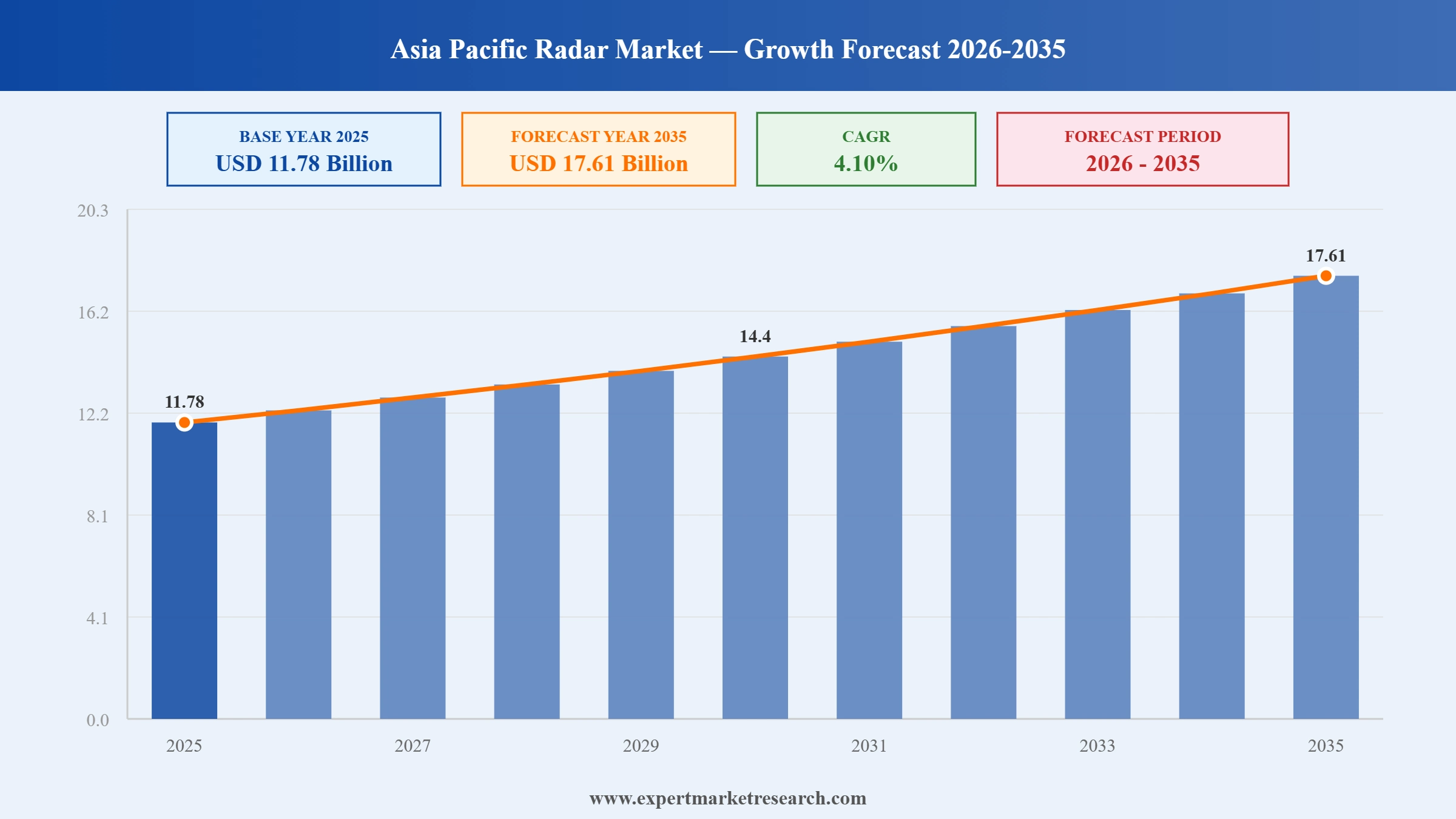
The Asia Pacific radar market reached around USD 11.78 Billion in 2025. The market is projected to grow at a CAGR of 4.10% between 2026 and 2035 to reach nearly USD 17.61 Billion by 2035.
Read more about this report - REQUEST FREE SAMPLE COPY IN PDF
| Asia Pacific Radar Market Report Summary | Description | Value |
| Base Year | USD Billion | 2025 |
| Historical Period | USD Billion | 2019-2025 |
| Forecast Period | USD Billion | 2026-2035 |
| Market Size 2025 | USD Billion | 11.78 |
| Market Size 2035 | USD Billion | 17.61 |
| CAGR 2019-2025 | Percentage | XX% |
| CAGR 2026-2035 | Percentage | 4.10% |
| CAGR 2026-2035 - Market by Country | India | 4.3% |
| CAGR 2026-2035 - Market by Country | Australia | 3.2% |
| CAGR 2026-2035 - Market by Radar Service | Support and Maintenance | 4.7% |
| CAGR 2026-2035 - Market by Platform | Space Based | 5.0% |
| 2025 Market Share by Country | India | 10.3% |
Radars are essential in the management and response to geopolitical tensions, especially in regions experiencing potential or active conflicts. The Asia Pacific is currently facing numerous geopolitical challenges. The strategic deployment of radar systems significantly bolsters national security, offers early detection of threats, and facilitates military operations.
Asia demonstrates a significant military sector characterised by substantial expenditure. In March 2023, China revealed a defence budget amounting to USD 224 billion. Subsequently, in August 2023, Taiwan announced its largest defence budget to date, proposing TWD 606.8 billion (USD 19.1 billion) for 2024. Furthermore, in November 2022, Japan outlined its intention to increase defence and related security spending to 2% of its GDP by 2027. Additionally, India maintains the title of the fourth-largest military force globally. Radar technology plays a crucial role in military and defence operations, providing a variety of applications that improve situational awareness, threat detection, and combat efficiency. Radars are employed to detect, track, and identify incoming enemy aircraft, including fighter jets, bombers, and unmanned aerial vehicles UAVs. This capability ensures early warning and facilitates prompt defensive measures, such as deploying interceptors or utilising surface-to-air missiles.
India’s Defence Acquisition Council approved defence acquisition proposals worth approximately ₹1.10 lakh crore, with the Indian Navy’s requirements including Arudhra radar systems. The approvals are part of a wider push to strengthen indigenous defence capabilities, with around 98% of the approved procurement value expected to come from domestic industry. Arudhra is an indigenous long-range, multi-function 4D radar developed by DRDO and produced by Indian industry. The approval strengthens domestic demand for advanced surveillance and air-defence radars and supports India's indigenous radar manufacturing ecosystem.
Japanese aerospace company IHI announced that its engineers and technicians had begun training with ICEYE ahead of assembling and testing two synthetic aperture radar (SAR) satellites in Japan. The two satellites are scheduled for assembly and testing at IHI facilities from around September 2026, with launches planned for the first quarter of 2027. The programme forms the first stage of IHI’s planned constellation of up to 24 SAR satellites. The initiative is strengthening Japan's domestic radar-based Earth-observation capabilities and creating opportunities for satellite radar manufacturing, integration and related services.
India removed licensing requirements for radio spectrum in the 77–81 GHz and 5.9 GHz bands, facilitating wider deployment of automotive radar and V2X technologies. The policy change enables automakers to introduce advanced driver-assistance systems without obtaining separate spectrum approvals for these applications. Radar operating in the 77–81 GHz range is widely used for functions such as adaptive cruise control, blind-spot detection and collision avoidance. The regulatory change lowers an important adoption barrier for automotive radar and could accelerate deployment of radar-based ADAS across India's rapidly expanding vehicle market, thereby shaping the trends of the Asia Pacific radar market.
India was reported to be developing an AI-enabled radar system designed to detect hypersonic missiles, addressing the difficulty of tracking targets travelling at speeds above Mach 5. The development focuses on improving detection and tracking despite the challenging electromagnetic conditions surrounding hypersonic vehicles. The initiative forms part of India's broader effort to strengthen indigenous radar and missile-defence capabilities through advanced signal processing and artificial intelligence. Development of AI-assisted high-speed target detection is pushing radar innovation towards faster processing, advanced signal discrimination and specialised defence applications in the Asia Pacific region.
The Asia Pacific radar market is seeing continued movement towards 77–81 GHz automotive radar, supported by the expansion of ADAS beyond premium vehicles. In June 2026, NXP launched its SAF8444 radar SoC, designed to support front and corner radar applications for functions including automated emergency braking and blind-spot detection. The chip is designed to operate in the automotive radar frequency band between 76 and 81 GHz and integrates radar processing with the embedded processor. This strategy is important in the case of the Asia Pacific region since high volumes of automotive manufacturing necessitate cheaper ADAS solutions. The trend is therefore shifting high-frequency radar from premium autonomous-driving applications towards broader passenger-vehicle deployment.
Radar manufacturers are increasingly integrating processing capabilities directly into radar SoCs, reducing dependence on separate computing hardware. NXP's SAF8444, introduced in June 2026, incorporates Arm Cortex-A53 and Cortex-M7 processing alongside radar-processing acceleration, enabling functions such as object classification and trajectory prediction at the sensor level. The architecture has the potential to cut down power consumption, heat dissipation, number of components, and overall complexity. This invention has significant implications for Asia Pacific’s expanding EV industry, wherein companies need to integrate advanced ADAS into their products but avoid increasing electronic complexity and energy consumption. As radar moves into more affordable vehicle categories, integrated processing can help manufacturers balance safety functionality with system cost and packaging constraints.
AI is increasingly being combined with radar data to improve object classification and scene understanding, particularly when cameras face poor visibility. Korean startup Deep Fusion AI demonstrated this direction at CES 2026 with a 4D imaging-radar perception system designed to identify pedestrians, vehicles and road features in rain, fog, dust and darkness. The technology leverages AI for gathering more detailed spatial data from the radar signals compared to traditional methods of sensing distances and speeds. The development is important in Asia Pacific due to the need for sensors that work reliably in varying weather and lighting conditions. As AI algorithms improve radar interpretation, the technology is increasingly positioned as a complementary perception layer alongside cameras and lidar rather than merely a collision-warning sensor, and thus creating immense demand in the Asia Pacific radar market.
Radar manufacturers and automotive developers are increasingly using hardware-in-the-loop (HIL) and over-the-air (OTA) testing to validate radar performance without relying entirely on physical road testing. In January 2026, researchers from the Automotive Research Association of India presented an OTA-HIL methodology specifically for automotive radar.The system is able to carry out dynamic tests on object detection, Doppler velocity, range, and angle of arrival in varying scenarios of distances, velocities, and environments for the target. The controlled tests are able to increase the repeatability while decreasing the dependence on expensive test tracks. In the case of Asia Pacific's growing ADAS ecosystem, such an approach can save time in developing radars.
The Asia Pacific radar market is also gaining momentum in space-based Earth observation, particularly through synthetic aperture radar and radar-optical fusion. In September 2026, Indian space startup GalaxEye secured a US patent for technology synchronising optical and radar sensors on satellites, allowing imagery to be captured accurately regardless of darkness or cloud cover. The company plans a constellation of 30 satellites over the next five years and has also acquired Bengaluru-based spacecraft engineering company StarOps. Radar's ability to operate through clouds and at night makes it valuable for applications including agriculture, disaster response, security and insurance. The development demonstrates how radar demand in Asia Pacific is extending beyond defence and automotive systems into commercial satellite intelligence and Earth-observation infrastructure.
Read more about this report - REQUEST FREE SAMPLE COPY IN PDF
The simultaneous expansion of the civil aviation and maritime sectors in emerging economies is driving a significant demand for advanced radar systems. These systems are essential for enhancing safety, improving operational efficiency, and supporting the sustainable growth of both air and maritime transportation networks. In the aviation sector, advanced radar systems can provide real-time data on weather patterns, enabling pilots to make informed decisions and avoid hazardous conditions. Similarly, in the maritime sector, sophisticated radar can assist in navigation and collision avoidance, ensuring safer passage for vessels in busy shipping lanes. As these sectors progress, the incorporation of advanced radar technologies is becoming increasingly vital.
Asia Pacific Radar Market Report and Forecast 2026-2035 offers a detailed analysis of the market based on the following segments:
Market Breakup by Component
Market Breakup by Radar Service
Market Breakup by Platform
Market Breakup by End Use
Market Breakup by Country
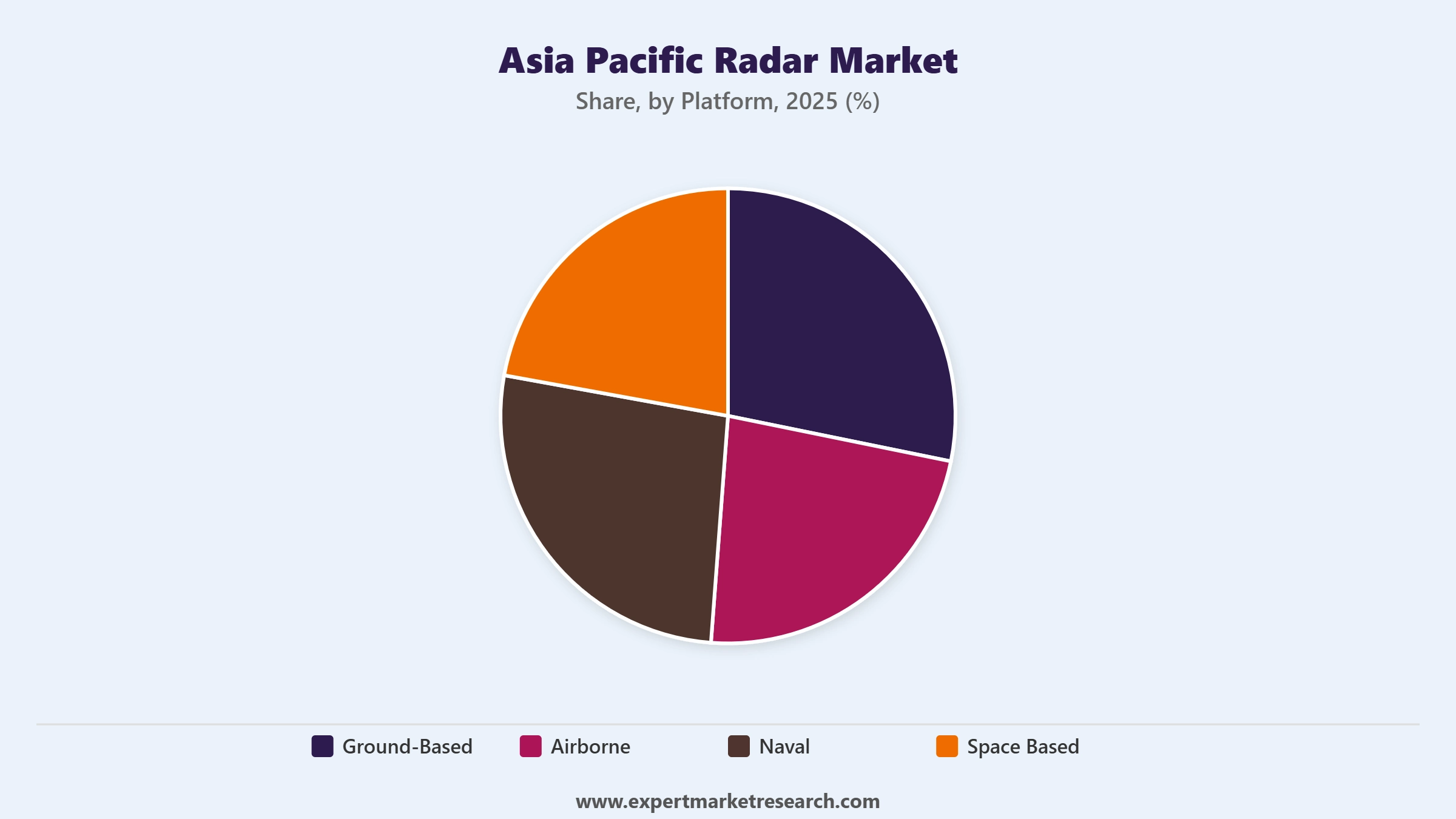
Based on the platform, the market is segmented into ground-based, airborne, naval, and space based. The space based segment is projected to grow at a CAGR of 5.0% during the forecast period of 2026-2035. Space-based radar serves as a robust instrument applicable to various fields, offering essential information that supports scientific research, enhances environmental monitoring, and bolsters security operations.
Read more about this report - REQUEST FREE SAMPLE COPY IN PDF
Major players are focusing on the adoption of advanced technologies to gain a competitive edge in the market.
The comprehensive report looks into the macro and micro aspects of the market. The EMR report gives an in-depth insight into the market by providing a SWOT analysis as well as an analysis of Porter’s Five Forces model.


Upto 15% Off
USD
$2499 $2249
$3999 $3599
$4999 $4249
$5999 $5099


*While we strive to always give you current and accurate information, the numbers depicted on the website are indicative and may differ from the actual numbers in the main report. At Expert Market Research, we aim to bring you the latest insights and trends in the market. Using our analyses and forecasts, stakeholders can understand the market dynamics, navigate challenges, and capitalize on opportunities to make data-driven strategic decisions.*
In 2025, the market attained a value of nearly USD 11.78 Billion.
The market is assessed to grow at a CAGR of 4.10% between 2026 and 2035.
The market is estimated to reach around USD 17.61 Billion by 2035.
The market is being driven by the thriving automotive sector and wide applications of radars in the maritime and aviation sectors.
The key trends aiding the market expansion include the increasing geopolitical tensions in the region and growing defence expenditure by countries in the Asia Pacific.
The major end uses of the radar are military applications, air traffic control, remote sensing, and ground traffic control, among others.
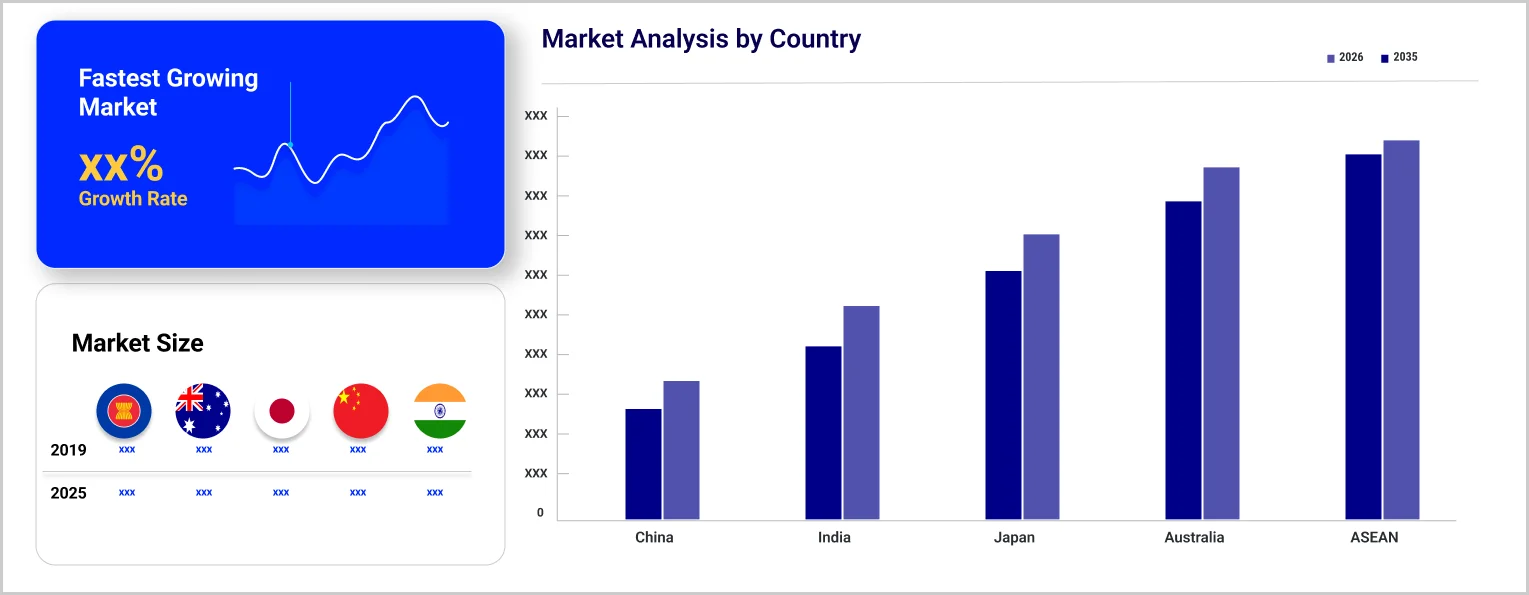
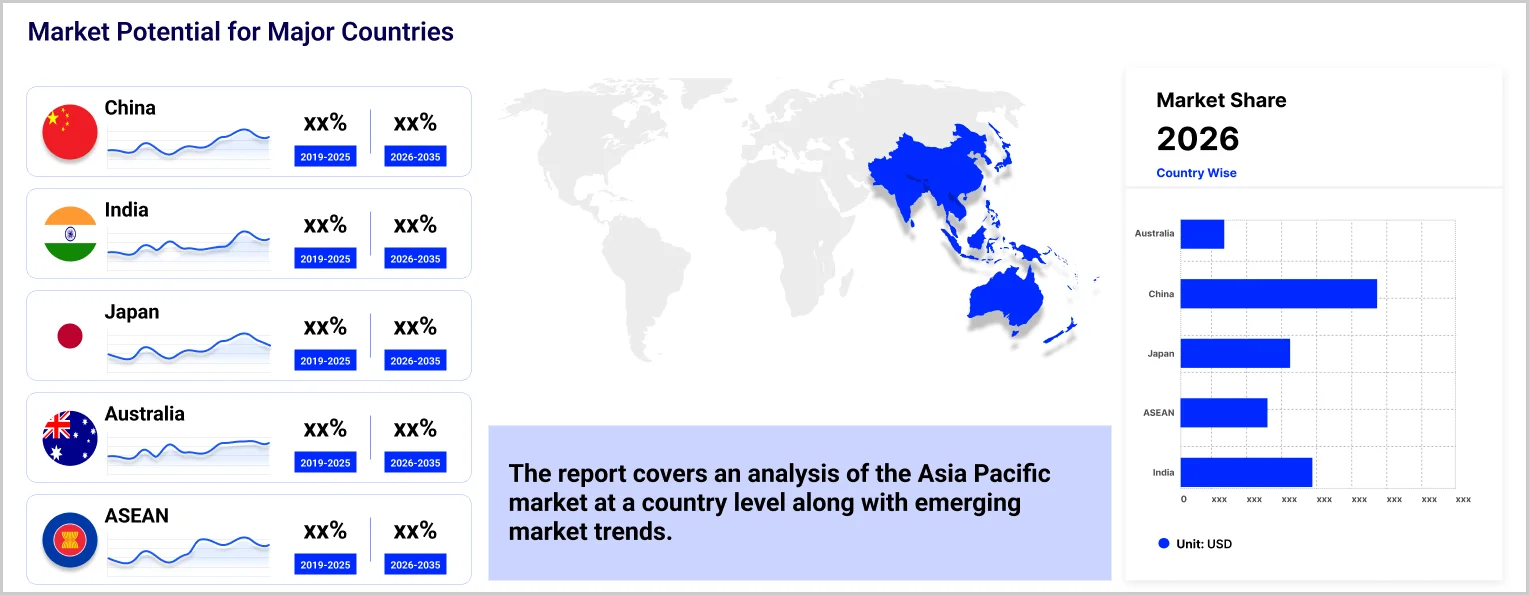
The major countries considered in the market are China, Japan, India, ASEAN, and Australia, among others.
The major players in the market are Honeywell International Inc., Lockheed Martin Corporation, Northrop Grumman Corp., BAE Systems Plc, RTX Corp., Thales S.A., Saab AB, SRC Inc., General Dynamics Corp., and Leonardo S.p.A, among others.
Explore our key highlights of the report and gain a concise overview of key findings, trends, and actionable insights that will empower your strategic decisions.
| REPORT FEATURES | DETAILS |
| Base Year | 2025 |
| Historical Period | 2019-2025 |
| Forecast Period | 2026-2035 |
| Scope of the Report |
Historical and Forecast Trends, Industry Drivers and Constraints, Historical and Forecast Market Analysis by Segment
|
| Breakup by Component |
|
| Breakup by Radar Service |
|
| Breakup by Platform |
|
| Breakup by End Use |
|
| Breakup by Region |
|
| Market Dynamics |
|
| Competitive Landscape |
|
| Companies Covered |
|
Datasheet
One User
USD 2,499
USD 2,249
tax inclusive*
Single User License
One User
USD 3,999
USD 3,599
tax inclusive*
Five User License
Five User
USD 4,999
USD 4,249
tax inclusive*
Corporate License
Unlimited Users
USD 5,999
USD 5,099
tax inclusive*
*Please note that the prices mentioned below are starting prices for each bundle type. Kindly contact our team for further details.*
Flash Bundle
Small Business Bundle
Growth Bundle
Enterprise Bundle
*Please note that the prices mentioned below are starting prices for each bundle type. Kindly contact our team for further details.*
Flash Bundle
Number of Reports: 3
20%
tax inclusive*
Small Business Bundle
Number of Reports: 5
25%
tax inclusive*
Growth Bundle
Number of Reports: 8
30%
tax inclusive*
Enterprise Bundle
Number of Reports: 10
35%
tax inclusive*
How To Order

Select License Type
Choose the right license for your needs and access rights.

Click on ‘Buy Now’
Add the report to your cart with one click and proceed to register.

Select Mode of Payment
Choose a payment option for a secure checkout. You will be redirected accordingly.
Strategic Solutions for Informed Decision-Making
Gain insights to stay ahead and seize opportunities.

Get insights & trends for a competitive edge.

Track prices with detailed trend reports.

Analyse trade data for supply chain insights.

Leverage cost reports for smart savings

Enhance supply chain with partnerships.

Connect For More Information
Our expert team of analysts will offer full support and resolve any queries regarding the report, before and after the purchase.
Our expert team of analysts will offer full support and resolve any queries regarding the report, before and after the purchase.
We employ meticulous research methods, blending advanced analytics and expert insights to deliver accurate, actionable industry intelligence, staying ahead of competitors.
Our skilled analysts offer unparalleled competitive advantage with detailed insights on current and emerging markets, ensuring your strategic edge.
We offer an in-depth yet simplified presentation of industry insights and analysis to meet your specific requirements effectively.




